
How Hard Is the CPA Exam? Here’s the Truth

If you’re Googling how hard the CPA exam is, there’s a good chance you’re asking a quieter question underneath it: Am I smart enough to pass this?
But let’s be clear: that’s a totally normal thought to have, and I’d bet that almost everyone who considers the CPA wonders the same thing. With those terrifying pass rates, frankly, it’s a logical thought to have.
So let’s talk honestly about what makes the exam hard, what kind of candidate can pass, and what “getting good enough” actually looks like.
Key Takeaways
- It’s Hard, Not Impossible: The CPA exam is demanding, but it tests consistency and understanding more than raw intelligence.
- Difficulty Comes From Volume: The amount of material and length of the process make the exam feel harder than the content itself.
- Pass Rates Need Context: Lower pass rates usually reflect preparation issues, not a lack of ability.
- You Get Better With Time: Most candidates struggle early and improve as patterns and concepts start to click.
- Discipline Beats Talent: Time management, repetition, and a realistic study plan matter more than being “naturally smart.”
Is the CPA Exam Hard?
Unfortunately, yes, the CPA exam is hard. In fact, it’s widely considered one of the most challenging professional exams in the U.S. Pass rates dipped as low as 37% in 2025 (specifically for BAR in Q1), due in part to testing four dense, complex sections under a strict time limit.
But to be clear, if you’re wondering if there’s some sort of trick to “outsmart” the exam, there really isn’t. The difficulty comes from volume, consistency, and pressure, which together define the CPA exam’s difficulty.
However, there are things you can do to weigh the odds in your favor. Let’s talk about them.
What the CPA Exam Actually Tests
A lot of fear comes from not knowing what you’re being tested on.
Across each CPA exam section, you’ll see a mix of:
- Multiple choice questions
- Task-based simulations
- Case study scenarios (that focus on judgment, not guessing)
The content spans core accounting topics like financial accounting, financial statements, journal entries, auditing concepts, tax law, and tax compliance. You’ll also see material tied to the business environment, controls, and business analysis.
The goal isn’t just to spot the correct answer. It’s to show that you understand why something works and how it applies in real situations. After all, the point of it isn’t just to force you to suffer through hardcore exams; it’s to prepare you for an actual career in accounting.
That’s what separates this exam from simpler tests, like a college final.
Let’s Talk CPA Pass Rates (Without the Panic)
People love to quote CPA exam pass rates, usually without context.
Each section has its own pass rate, and the average pass rate typically sits around the 40–50% range, depending on the section and testing window. That sounds rough, and it can be, but it doesn’t mean half of CPA candidates “aren’t smart enough.”
It means many CPA candidates:
- Underestimate the time required
- Study inconsistently
- Sit before they’re ready
Here are the 2025 cumulative pass rates for all sections, rounded to the nearest whole percentage:
| Section | Pass Rate |
|---|---|
| AUD | 48% |
| FAR | 42% |
| REG | 63% |
| BAR | 42% |
| ISC | 68% |
| TCP | 78% |
It’s worth mentioning that both ISC and TCP, with pass rates of 68% and 78% respectively, are discipline sections, of which you have to choose one of three total. So, if either appeals to you, choosing one may make your path to licensure a little bit easier.
How Long Does It Take to “Get Good”?s
This is one of the most misunderstood parts of the exam process.
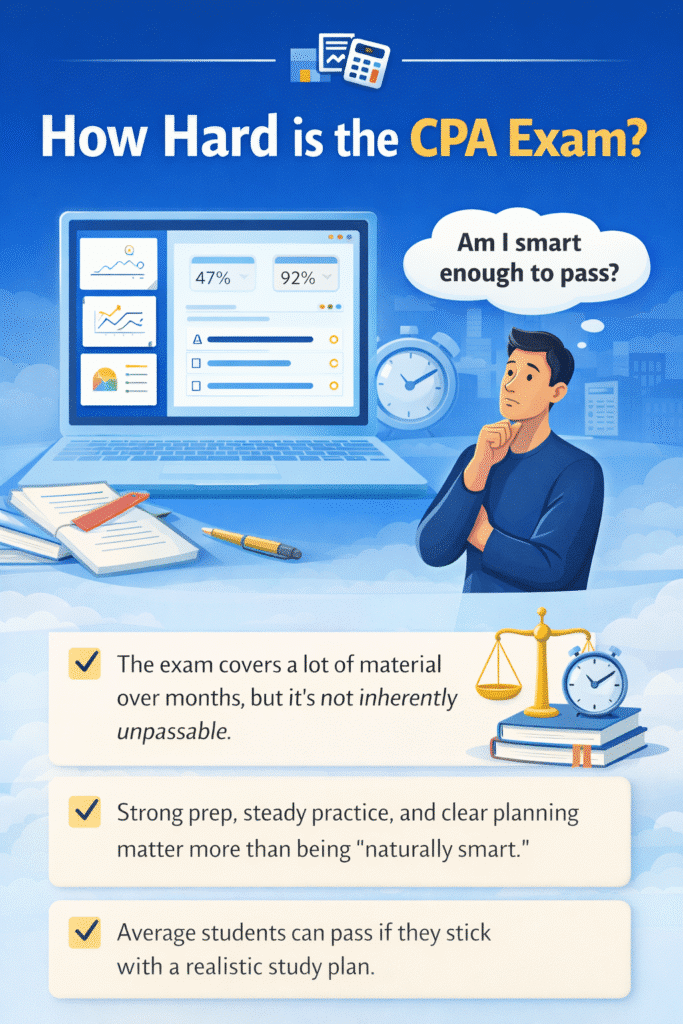
Most people don’t feel confident early on, but that’s normal (and frankly, expected). Early studying often feels slow because you’re building foundations. Things usually click later, once patterns repeat and concepts connect.
For many candidates:
- The first 4–6 weeks feel uncomfortable
- Weeks 7–10 feel more controlled
- The final stretch is about review and endurance
That’s where practice questions, a solid test bank, and repeated practice tests matter (and to be clear, lots and lots of repetition, not just a handful of attempts). You’re not just learning content. You’re learning how the exam thinks, and mimicking your outcome on the actual exam.
Working through a set of CPA practice exam questions shows how those layered prompts are actually framed.
What Actually Makes the CPA Exam Hard
If I had to boil it down, this is what really makes the CPA exam difficult:
- Sheer volume of material
- Long study timelines
- Heavy emphasis on application
- Pressure from work and life
- Strict passing score requirements
Add in a fixed exam schedule and the stress of exam day, and it’s easy to see why people struggle. The exam rewards discipline more than brilliance. In fact, if there are any psychology nerds, it’s a lot like Angela Duckworth’s research on “grit,” of which one of the major findings was:
In a study of 11,000 West Point cadets, those with higher grit had 54% greater odds of completing Beast Barracks, the academy’s grueling six‑week initiation training, outperforming both cognitive and physical ability as predictors of success.
The Role of CPA Exam Prep
The difference between struggling and steady progress often comes down to preparation.
Good CPA prep doesn’t mean endless hours. It means using one of the top CPA prep courses, following a realistic study plan, and sticking to it even when motivation dips.
Strong prep focuses on:
- Repeated practice exams
- Targeted practice questions
- Reviewing why answers are wrong
That’s where CPA exam success usually comes from, not last-minute cramming.
Skills That Matter More Than Intelligence
This exam doesn’t reward raw brainpower the way people think.
It rewards:
- Time management skills
- Consistent time management
- Patience
- Critical thinking under pressure
You don’t need to be a genius. You need to show up, follow a plan, and keep going when it feels uncomfortable.
That’s why so many aspiring accountants eventually pass, even after setbacks.
So… Are You Smart Enough?
Short answer: probably, yes—if by “smart” you mean capable of learning and applying rules consistently.
We’ve talked about it, but to reiterate, the CPA exam doesn’t require advanced math, genius-level memory, or creative brilliance. What it tests is whether you can understand accounting rules, apply them correctly, and do that under time pressure. If you’ve handled college-level accounting, learned complex policies at work, or stuck with a long-term project before, you already have the raw ability the exam demands.
So if you’re asking whether you’re “smart enough,” a better question is this: Can you follow a plan, study even when it’s boring, and keep going when progress feels slow?
If the answer to that is yes, then you’re smart enough to pass.
Conclusion
The CPA exam is hard, but it’s not unfair. It demands time, focus, and consistency more than anything else.
If you’re willing to treat it like a long-term project instead of a short sprint, the difficulty becomes manageable. Thousands of candidates pass every year, not because they’re exceptional, but because they put in the work.
If you’re asking these questions, you’re already thinking the right way.
FAQs
Yes. The CPA exam covers more material and expects you to apply concepts, not just remember them.
Many candidates don’t feel confident until several weeks into studying, once repetition starts paying off.
No. Pass rates mostly reflect preparation habits, time constraints, and exam strategy.
Yes. Many newly licensed CPAs were not top students but followed a consistent study plan.
Time pressure, long question sets, and the need to apply rules quickly make the exam mentally exhausting.
