If you’re exploring advanced credentials in the accounting profession, you’ve likely come across the Certified Management Accountant (CMA) designation.
But what is a CMA?
It all starts with the Institute of Management Accountants’ CMA Program. In this guide, I’ll touch on key career factors, work tasks, and education requirements to help you determine not only what a CMA is, but whether it’s the right fit for your career path.
Key Takeaways
- Corporate-Focused Credential: The CMA is built for professionals pursuing financial management and internal strategy roles rather than public accounting.
- Globally Recognized Certification: The CMA credential is administered by the Institute of Management Accountants and is respected worldwide.
- Two-Part Exam Structure: The CMA exam covers financial planning, performance, analytics, and strategic financial management.
- Leadership-Oriented Career Path: CMAs commonly advance into corporate finance, performance management, and executive roles.
- Education and Experience Required: Candidates must hold a bachelor’s degree and have relevant work experience to earn the certification.
What Does a CMA Do?
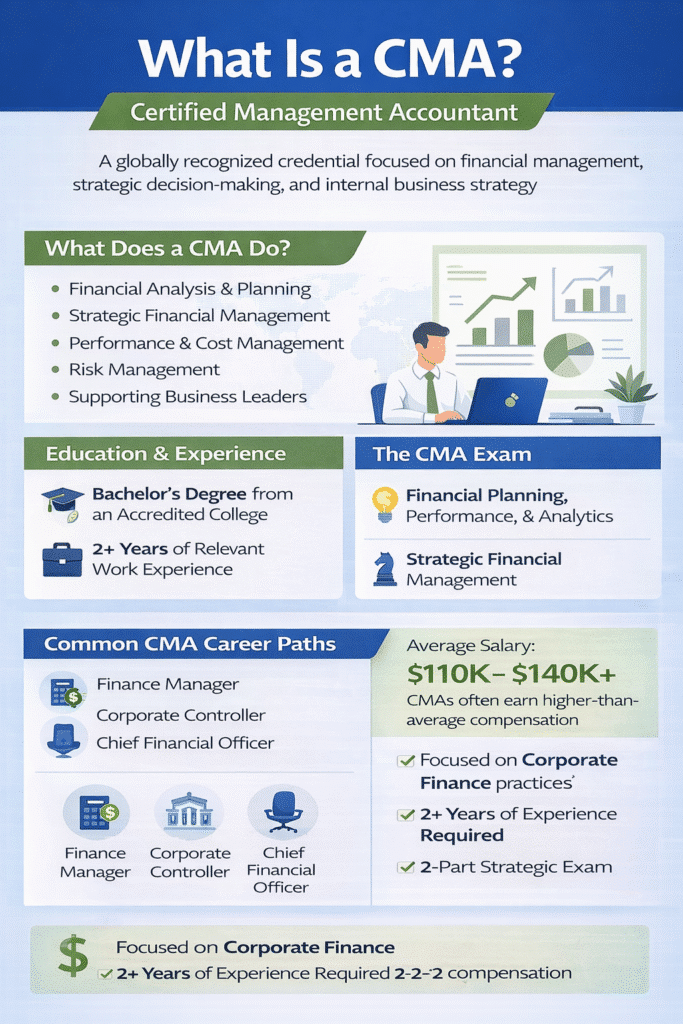
A CMA typically works in corporate accounting, corporate finance, or financial planning roles within an organization. Instead of preparing audit reports or working primarily with accounting firms, CMAs help leadership teams make informed financial decisions.
Their work often includes:
- Financial analysis and forecasting
- Strategic financial management
- Performance management and cost management
- Risk management and analysis, risk evaluation
- Budgeting and capital planning
- Interpreting financial statements for internal strategy
In short, a CMA helps business leaders improve profitability, manage risk, and drive strategic initiatives.
Who Oversees the CMA Credential?
The CMA credential is administered by the Institute of Management Accountants (IMA). The IMA sets the standards for the CMA program, including exam content, professional ethics requirements, and continuing education expectations.
Because the certification is issued through the IMA rather than a state board, it is recognized globally. That makes it especially valuable for professionals working in multinational corporations or international corporate finance roles.
CMA vs CPA: What’s the Difference?
While both credentials are respected within the accounting profession, they serve different purposes.
A Certified Public Accountant is typically associated with public accounting, tax compliance, and regulatory reporting. The CPA route is common for those working in accounting firms or pursuing audit and assurance careers.
The CMA certification, on the other hand, is built for professionals who want to influence internal financial decisions. It emphasizes management accounting, strategic management, and operational performance rather than compliance-focused reporting.
If you’re deciding between the two, it often comes down to whether you see yourself advising external stakeholders or shaping internal corporate strategy.
What Are the CMA Education and Experience Requirements?
To earn the CMA certification, candidates must meet specific education and experience requirements set by the IMA.
You must:
- Hold a bachelor’s degree from an accredited institution
- Complete two continuous years of relevant professional experience in management accounting or financial management
- Pass both parts of the CMA certification exam
Your bachelor’s degree does not have to be in accounting, but many candidates hold an accounting degree or a finance degree from an accredited college. What matters most is meeting the IMA’s eligibility standards and gaining qualifying work experience.
What Is the CMA Exam Like?
The CMA exam is divided into two parts:
- Financial Planning, Performance, and Analytics
- Strategic Financial Management
Each part of the CMA certification exam tests applied knowledge rather than rote memorization. Topics include corporate finance, cost management, performance management, risk management, and advanced financial analysis.
The exam format includes multiple-choice questions and essay scenarios that require candidates to demonstrate real-world decision-making skills. This structure ensures CMAs can translate theory into business applications.
It’s highly recommended to study efficiently with one of the top CMA review courses to help you pass.
What Career Paths Does a CMA Open?
The CMA credential is especially valuable in corporate accounting and finance leadership tracks. Common roles include:
- Financial analyst
- Cost accountant
- Corporate controller
- Finance manager
- Director of Financial Planning
- Chief Financial Officer
Because the CMA focuses on internal strategy and analysis, it aligns well with long-term leadership roles within organizations.
Some professionals also combine the CMA with other credentials, such as the Certified Treasury Professional, to broaden expertise in specialized areas of corporate finance.
How Much Do CMAs Earn?
Salary can vary based on experience, industry, and geographic location, but CMAs consistently report strong compensation compared to non-certified peers.
According to industry surveys, the median annual salary for CMA holders tends to exceed that of accounting professionals without certification. The credential signals advanced expertise in strategic financial management and corporate decision-making, which employers value in leadership roles.
Is the CMA Right for You?
The CMA is best suited for professionals who:
- Prefer working inside organizations rather than in public accounting
- Enjoy financial analysis and performance optimization
- Want to move into corporate finance or strategic management roles
- Value a globally recognized professional credential
If your goal is to influence how companies allocate resources, manage costs, and evaluate risk, the CMA certification can provide a strong foundation.
Final Thoughts
The Certified Management Accountant designation is not just another line on a résumé. It’s a specialized professional credential focused on management accounting, financial management, and strategic decision-making. For those seeking leadership roles in corporate finance rather than compliance-driven positions, the CMA program offers a clear and focused path forward.
FAQs
A CMA works in corporate finance and management accounting roles, focusing on financial analysis, strategic decision-making, cost management, and performance evaluation within an organization.
Neither credential is universally better. The CMA is stronger for internal financial management roles, while the CPA is typically better suited for public accounting and regulatory reporting careers.
Most candidates complete the two-part CMA exam within 12 to 18 months, though timing depends on their preparation pace and when they meet the education and experience requirements.
You need a bachelor’s degree from an accredited institution, but it doesn’t have to be in accounting as long as you meet the eligibility requirements.
CMAs often earn higher-than-average compensation compared to non-certified accounting professionals, especially in corporate finance and leadership positions.