If you’re struggling to fit your favorite CPA prep course into your budget or you just want to see if you can save some of your money for a rainy day, we’ve got the best CPA review course discounts for you. These promotions have been gathered from the top-rated CPA exam prep companies that offer the most effective CPA study materials on the market today.
Trust me, you don’t want to miss out on these amazing deals!
These are the Best CPA Review Courses & Discounts in 2026:

 TODAY'S BEST OFFER
Extended Sale – $1,346 Off Becker CPA Pro+
See Details

Save $1,249 On Gleim CPA Traditional
See Details
Take $1,600 Off UWorld CPA Elite-Unlimited Course
See Details

CPA Exam Prep Course Discounts & Promo Codes in 2026
See Details
If you’re struggling to fit your favorite CPA prep course into your budget or you just want to see if you can save some of your money for a rainy day, we’ve got the best CPA review course discounts for you. These promotions have been gathered from the top-rated CPA exam prep companies that offer the most effective CPA study materials on the market today.
Trust me, you don’t want to miss out on these amazing deals!
These are the Best CPA Review Courses & Discounts in [y]:
[discountcode show_sorting="yes" pin="becker-cpa-review-promo-codes,gleim-cpa-promo-codes,uworld-cpa,surgent-cpa-promo-codes"]If you want to land a rewarding job at one of the big 4 accounting firms, you’re going to have to hit the books. The best way to ensure you become an asset so valuable that one of the big 4 has to hire you is to master everything there is to know about public accounting.
There’s just one problem: this process can be very expensive.
If you’re studying to become a CPA and taking it seriously, you’re going to need a CPA exam review course. Although they’re definitely worth the money, and many providers offer helpful financing options, the truth of the matter is that these courses don’t come cheap.
CPA Exam Prep Course Discounts & Promo Codes in 2026
See Details
If you’re struggling to fit your favorite CPA prep course into your budget or you just want to see if you can save some of your money for a rainy day, we’ve got the best CPA review course discounts for you. These promotions have been gathered from the top-rated CPA exam prep companies that offer the most effective CPA study materials on the market today.
Trust me, you don’t want to miss out on these amazing deals!
These are the Best CPA Review Courses & Discounts in [y]:
[discountcode show_sorting="yes" pin="becker-cpa-review-promo-codes,gleim-cpa-promo-codes,uworld-cpa,surgent-cpa-promo-codes"]If you want to land a rewarding job at one of the big 4 accounting firms, you’re going to have to hit the books. The best way to ensure you become an asset so valuable that one of the big 4 has to hire you is to master everything there is to know about public accounting.
There’s just one problem: this process can be very expensive.
If you’re studying to become a CPA and taking it seriously, you’re going to need a CPA exam review course. Although they’re definitely worth the money, and many providers offer helpful financing options, the truth of the matter is that these courses don’t come cheap.
How to Become a CFA®: Your Step-by-Step Career Guide
See Details
If you’re thinking about becoming a CFA®, you’re probably serious about working in finance, whether you’re already in the field or trying to break in. Either way, with every article on the subject giving you a labyrinth to work through to get a solid path…
So, I wrote the step-by-step guide on how to become a CFA.
I’ll walk you through each step so you know exactly what to do, when to do it, and what to expect along the way.
Key Takeaways
- The CFA® Is a Long-Term Commitment: Becoming a CFA takes time, discipline, and consistency, but the payoff can be worth it.
- You Need a Clear Step-by-Step Plan: Eligibility, registration, studying, exams, and work experience all follow a defined path.
- Smart Studying Beats Long Studying: Consistent practice questions, mock exams, and review sessions matter more than cramming.
- Ethics Aren’t Optional: Ethics play a major role in the exams and in real-world investment decision-making.
- The Charter Opens Career Doors: The CFA can unlock roles across investment management, analysis, and portfolio-focused careers.
Step 1: Understand What the CFA® Charter Really Is
Before you sign up for anything, you need to know what you’re getting into.
The CFA charter is offered by the CFA Institute. It’s designed for people who want careers in investment management, research, and related roles. Many investment professionals pursue it to sharpen their skills and boost credibility.
What does the program focus on?
- The investment decision-making process
- Ethics and professional standards
- Real-world applications across wealth management and beyond
While tests are a big part of earning CFA status, you’ll need to go beyond passing; you have to learn how smart financial decisions actually get made.
Step 2: Check the Basic Requirements
Let’s make sure you’re eligible.
To enroll, you’ll need at least one of the following:
- A bachelor's degree
- Final-year student status
- Relevant professional experience
That’s it. No GMAT. No fancy prerequisites.
Once you qualify, you can officially register for the CFA program and start planning your journey.
Step 3: Learn What You’ll Study (and Why It Matters)
The curriculum is broad, but that’s a good thing. You’ll master a wide variety of subjects in the finance industry, making you more well-rounded (and expanding your lineup of job opportunities).
You’ll study topics like:
- Investment analysis and valuation basics
- Portfolio management strategies
- Corporate finance and capital decisions
- Equity investments and market behavior
- Risk management tools used by firms
- Ethics, including a formal professional conduct statement
This knowledge translates directly into managing client portfolios and making smarter calls on asset valuation.
Step 4: Understand the CFA Exam Structure
Now let’s talk about the big hurdle: the CFA exam.
There are three levels. You must pass each one in order.
Each level builds on the last, moving from concepts to application to judgment.
- Level I: Fundamental concepts and tools
- Level II: Asset analysis and valuation
- Level III: Portfolio strategy and client decisions
When you register for each exam level, you’ll get to pick an exam date. Make sure you’re giving yourself enough time to properly prepare.
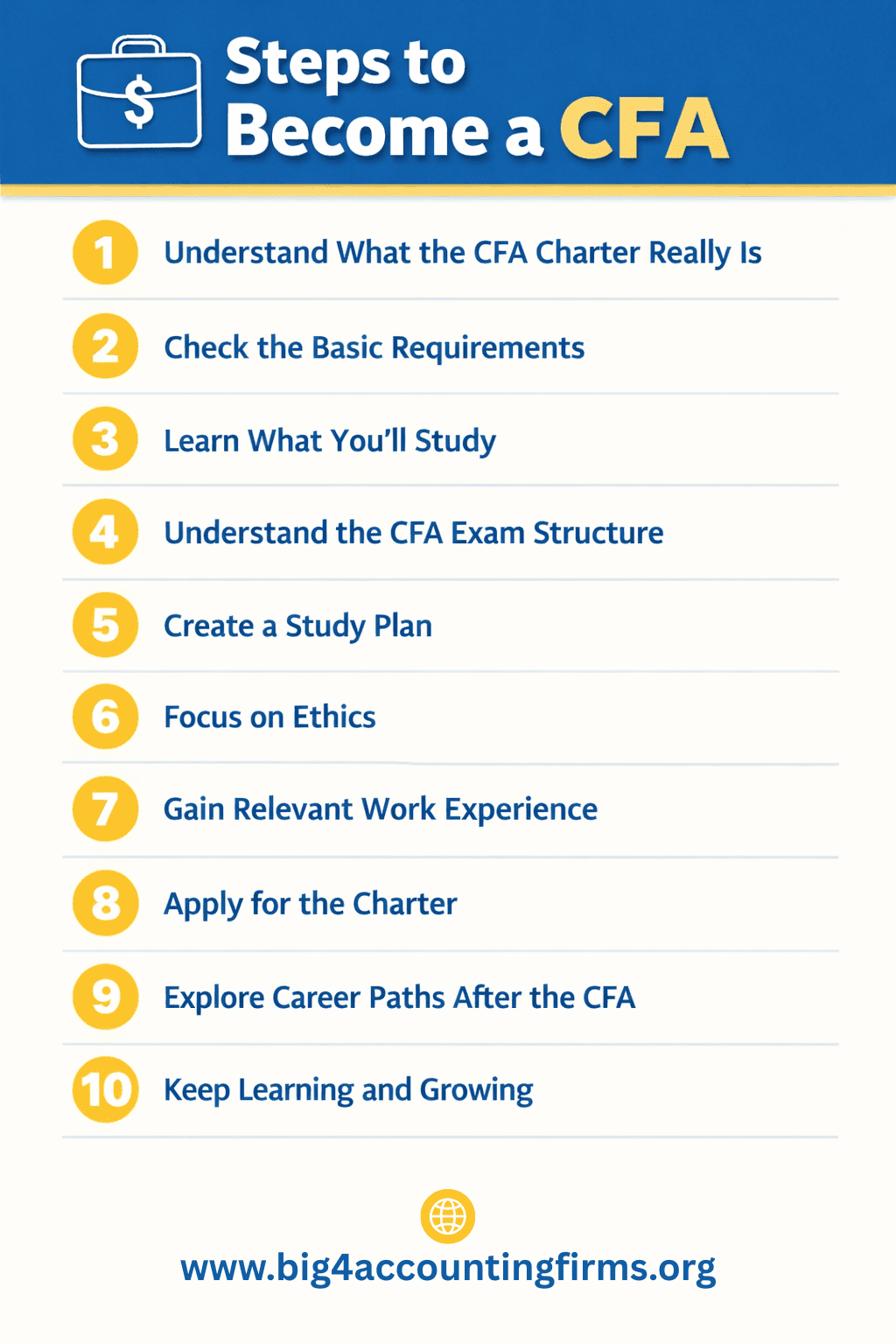
Step 5: Create a Study Plan With a CFA Prep Course That Actually Works
Here’s where most people struggle. Not because they aren’t smart, but because they don’t plan.
I suggest starting at least six months before your exam. Use one of these top CFA prep courses that help you study efficiently. Then break it down.
A simple weekly plan might include:
- Reading a small section each day
- Reviewing notes every weekend
- Answering practice questions regularly
Don’t wait until the end to test yourself. Use practice exams and full mock exams early and often. They help you spot weak areas before it’s too late.
Step 6: Focus on Ethics (Yes, Really)
Many candidates underestimate ethics. Don’t be one of them.
The ethics category ties directly to ethical practices expected across the financial industry. It also shows up heavily on exams and in real work situations.
Why does this matter?
Because employers want people they can trust, as do clients. Ethics guide how you handle money that isn’t yours, which is kind of a big deal.
Step 7: Gain Relevant Work Experience
Passing exams isn’t enough. To become a CFA charterholder, you’ll also need qualifying work experience.
This usually means roles involving:
- Research
- Analysis
- Decision support
Jobs in the broader finance industry count, especially if they connect to investments or analysis.
I recommend tracking your experience hours early and often. It’s easier to track as you go than to come back and figure it all out later—in that way, it’s a lot like taxes.
Step 8: Apply for the Charter
Once you pass all three exams and complete your experience, you can apply for the Chartered Financial Analyst designation.
This includes:
- Submitting work history
- Agreeing to ongoing professional responsibilities
- Staying aligned with high standards
When approved, congrats. You’ve earned it.
Step 9: Explore Career Paths After the CFA
So, what’s next?
Well… Your career!
Common career opportunities include:
- Research analyst
- Portfolio manager
- Risk analyst
- Advisor roles in wealth management
Some professionals focus on investment support, while others opt for a strategic position. Either way, the charter gives you credibility and flexibility to choose the right path for you.
Step 10: Keep Learning and Growing
The CFA journey doesn’t end once you get the charter. In fact, that’s just the foundation—not the finish line.
Markets change. Tools evolve. Expectations rise. And simply put? Staying current helps you stay valuable.
So naturally, your charter is a huge accomplishment, but don’t get lost in the steps. Think about what you want from your future, and how your CFA status can help you achieve those goals.
Conclusion
If you’ve made it this far, here’s the big picture.
You don’t need to have everything figured out today; you just need a plan. Start by making sure you’re eligible (or will be in the near future). Get registered, pick an exam date, study consistently, practice often, and gain real-world experience.
Then, apply for that hard-earned Chartered Financial Analyst designation.
If you’re willing to commit, take it step by step, and show up day after day, even when it gets hard (and it will), becoming a CFA is absolutely achievable. And trust me, future-you will be glad you started today.
FAQs
No. While it helps, many candidates come from non-finance backgrounds and learn the fundamentals through the curriculum.
Most people take about four to five years, including exams and required work experience.
It’s known for being challenging due to depth and volume, not trick questions or advanced math.
Yes. Most candidates work full-time and study early mornings, evenings, or weekends.
Roles in investment analysis, portfolio management, asset management, and wealth management benefit the most.
What Is a CPA? Accounting, Certification, and Career Paths
See Details
Acronyms are great to drop in a conversation where everyone’s “in the know,” but for the rest of us, they can be pretty confusing. So, naturally, a lot of people hear this term out in the wild and wonder:
What is a CPA?
Luckily, it’s pretty simple; a CPA is just a highly trusted type of accountant who’s earned a special title and a lot of responsibility. I’m going to walk you through what a CPA does, why it matters, and what a CPA career can actually be like.
Key Takeaways
- CPA = Certified Expert: A CPA is a licensed accountant who’s passed the CPA Exam, met education requirements, and earned serious trust.
- Not Just Taxes: CPAs can work in auditing, consulting, forensic accounting, payroll, and even fraud investigation—not just tax prep.
- The CPA Exam Is No Joke: Getting certified means tackling a tough 4-part CPA exam, meeting education and experience rules, and staying current.
- You Don’t Need to Be a Math Genius: CPAs rely more on logic, rules, and analysis than advanced math; critical thinking matters more.
- Career Flexibility Is Huge: CPAs can work for firms, startups, or themselves, and in just about every industry that touches money (so… all of them).
So What Is a CPA, Really?
A CPA stands for Certified Public Accountant. That means two things right off the bat:
- They’re certified — proven they know their stuff.
- They’re public — licensed to work for you or businesses, not just inside one company.
If you picture someone who understands taxes, money, numbers, and financial rules better than most people, you’re starting to get the idea of a CPA. But there’s a lot more to it than filling out tax forms.
Many aspiring finance professionals want to know: Is this career worth it? What does the day‑to‑day actually look like? Is it stressful? These are real questions, and I’ll answer them in a way that actually makes sense.
The Basics: What a CPA Actually Does
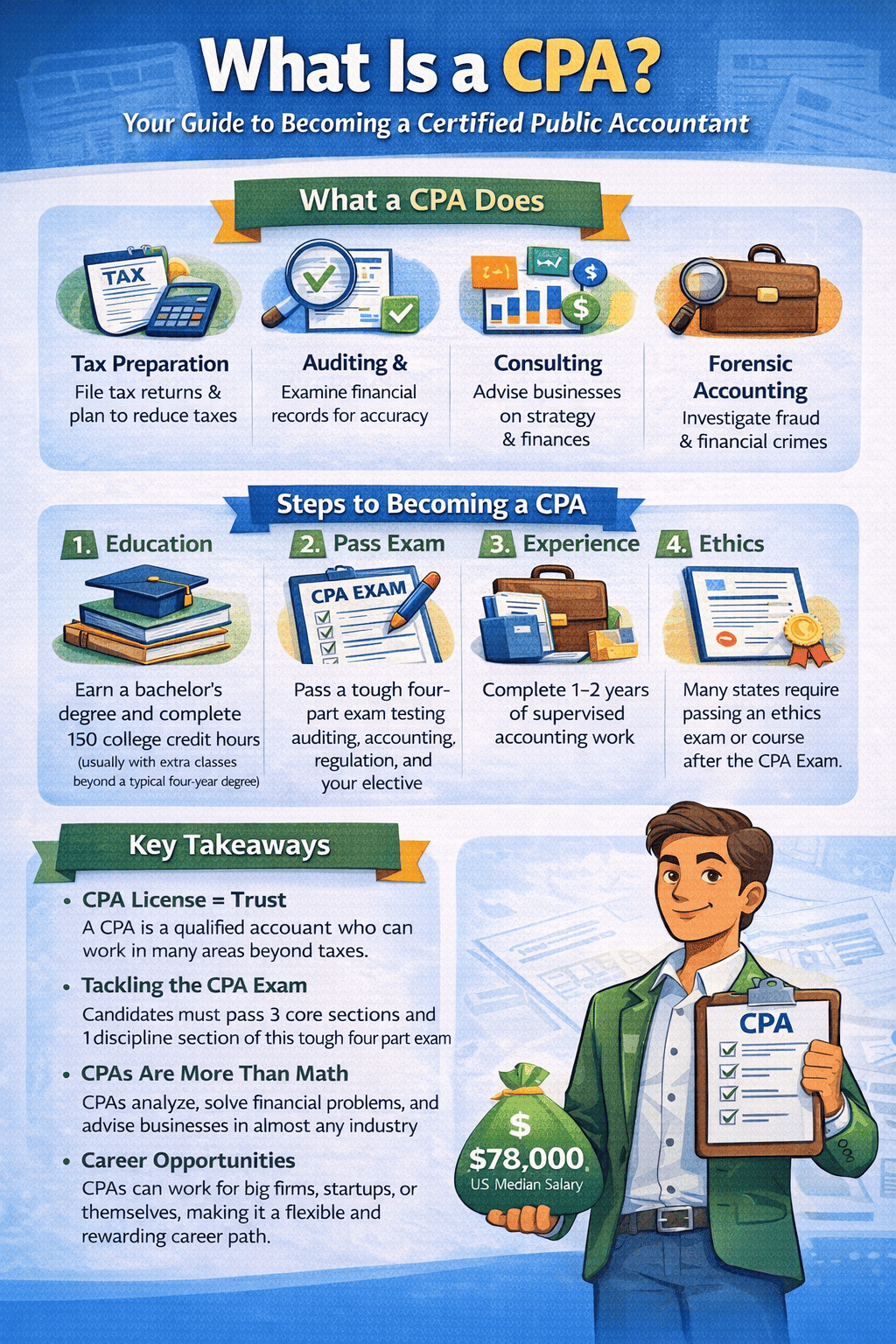
Let’s break down the typical work a CPA might do:
Tax Preparation and Planning
- CPAs prepare tax returns for individuals and businesses.
- They help clients reduce what they owe legally.
- They make sure everything is filed correctly and on time.
Taxes can be confusing. If you’ve ever done your own tax return and thought, “Wait… what?”, a CPA is like the friend who finally explains it in plain English.
Auditing and Assurance
- CPAs can audit financial statements.
- That means they check if a company’s numbers are accurate.
- Banks, investors, and regulators care a lot about this.
Imagine a financial “health check” but for a business. That’s what audits are.
Consulting and Advisory
- CPAs give financial advice.
- They help with budgeting, planning, and decision‑making.
- They often work with business owners to grow profits and cut waste.
So a CPA doesn’t just look backward at taxes; they also look forward at strategy.
Forensic Accounting
- Some CPAs investigate financial wrongdoing.
- They might work on fraud cases or legal disputes.
- This is like being a detective with numbers.
It’s not as common as taxes or audits, but it’s a cool niche and well‑paid.
Payroll and Bookkeeping
- CPAs might help businesses manage payroll.
- They sometimes oversee day‑to‑day records before handing them off to specialists.
Smaller firms love CPAs because they can wear a lot of hats. Unfortunately, however, very small firms can take advantage of that, so CPAs have to be careful where they decide to work. Generally speaking, go for corporate over a “mom and pop shop.”
How Do You Become a CPA?
Here’s how someone earns that CPA letters after their name:
1. Education
You usually need a bachelor’s degree, often in accounting or finance. Most states require 150 college credit hours, which is a bit more than a typical 4‑year degree. Some people finish with a master’s to hit that requirement.
2. Exam
The CPA Exam is a big deal. It’s hard (with a pass rate as low as 37.64% in 2025) and has six sections, though students only have to take four.
Required, or “core” sections, include:
- AUD: Auditing and Attestation
- FAR: Financial Accounting and Reporting
- REG: Taxation and Regulation
Then, candidates choose one of the following discipline sections:
- BAR: Business Analysis and Reporting
- ISC: Information Systems and Control
- TCP: Tax Compliance and Planning
3. Experience
Almost every state says you need a year or two of supervised experience before you’re fully licensed.
4. Ethics
Many states require an ethics test or course. Because CPAs are trusted with money, ethics matter.
Once all that is done, congratulations; you’re a CPA.
Why People Choose to Become a CPA
So what’s the draw? Here are some of the biggest reasons people chase the CPA:
Career Stability
People and businesses always need financial help. Whether the economy booms or slows, someone’s got to do the numbers. As a result, becoming a CPA is one of the more stable options out there, even with the introduction of AI to the industry.
Good Pay
CPAs tend to earn more than non‑licensed accountants. The certification signals trust and skill, and employers pay for that. In part, it’s because clients want to see a CPA, and that means more business for the firm.
Wide Range of Work
You could:
- Do taxes part of the year and strategy the rest.
- Work in a big firm or start your own practice.
- Specialize in tech, healthcare, or fraud detection.
It’s flexible. You get to “choose your own adventure” based on your income goals, ideal work environment, and desired lifestyle.
Respect and Trust
Let’s be honest: people take CPAs seriously. If your title has “CPA” behind it, you’re not just “an accountant.” Instead, you’re THE person companies trust with financial decisions.
What Being a CPA Is Like Day‑to‑Day
Now, let’s dig into the reality:
Busy Seasons Exist
For most CPAs, tax season (January–April) is like Final Exam Season every day. Lots of hours and deadlines.
Client Work
You spend a lot of time asking questions like:
- “Can you explain this transaction?”
- “Do you have documentation for this expense?”
- “When did you receive this income?”
As a result, communication matters almost as much as accounting. Introverts may feel overwhelmed by the responsibilities, which often require regular meetings, phone calls, and digital correspondence.
Problem Solving
You don’t just plug numbers into a form; you interpret data. Why did this change? How does this affect new decisions moving forward?
Continuing Education
CPAs have to keep learning because the rules are constantly changing. If you don’t stay current, you don’t stay certified, and this requires some extra organization (and hours invested) on the CPA’s end.
Common Misconceptions About CPAs
Let’s clear up a few myths:
Myth: CPAs Only Do Taxes
Nope. Taxes are a big part, but they also audit, advise, and strategize.
Myth: CPAs Are Only for Rich People or Big Companies
Nope again. Individuals, small business owners, startups; all kinds of people use CPAs.
Myth: You Have to Be a Math Genius
Not really. You need to be comfortable with numbers and logic, but it’s not advanced calculus. It’s more about understanding rules and applying them.
Who Should Consider Becoming a CPA?
Becoming a CPA isn’t for everyone — but here’s who it does make sense for:
- You like structure and rules.
- You enjoy solving puzzles (even financial ones).
- You communicate well with clients and teams.
- You want a role that blends numbers with business decisions.
- You want a credential that opens doors in finance and accounting.
If you love accounting but also like working with real people and solving real problems, being a CPA could be a great fit.
Conclusion: Is Being a CPA Worth It?
Being a CPA feels like having a backstage pass to the financial world. You get to see how businesses operate, help people reach goals, and be the person others rely on when the numbers matter.
It’s not always easy (the exam is tough and the work can be intense), but for many, that challenge is part of the appeal. If you like structured problem‑solving, want a career you can build on, and enjoy helping others make smart choices with their money, becoming a CPA could be one of the best decisions you make.
Ready to get started? Learn the steps to becoming a CPA and check out the top CPA review courses.
FAQs
CPA stands for Certified Public Accountant. It’s a license that shows an accountant has met strict education, exam, and experience standards.
Nope. Many CPAs specialize in audits, consulting, financial strategy, fraud investigations, and other areas beyond just tax preparation.
Yes, most people find it challenging. It has four parts, takes serious studying, and often requires multiple tries to pass all sections.
It’s possible, but you’ll still need to meet specific education requirements — usually 150 college credit hours with core accounting courses.
It typically takes around 5–7 years total, including college, passing the exam, and completing the required work experience.
How to Become a CPA: 8 Steps to Accounting Success
See Details
If you’re curious about joining nearly 700,000 other accounting professionals in the United States, you’re probably just digging into the “how to become a CPA” search results.
My goal? Now that you’re here, let’s get all of your questions answered in this article (and avoid that 2 AM Google search rabbit hole).
In this guide, I’ll walk you through the process from start to finish so you can move forward with confidence and a clear plan.
Key Takeaways
- The CPA Path Is Structured: Education, exams, experience, and licensure all follow a defined order.
- Education Comes First: You must meet specific credit and coursework rules before you can sit for the exam.
- The Exam Is the Biggest Hurdle: Passing the Uniform CPA Exam requires steady prep and a clear study plan.
- Experience Turns Knowledge Into Skill: Supervised work is required before you can become licensed.
- Licensure Is the Finish Line: Applying for and receiving your CPA license is the final step in the process.
Step 1: Understand What a CPA Actually Does
A CPA is more than just an accountant with extra letters. A licensed CPA can take on responsibilities that others can’t, including signing reports, offering certain opinions, and working directly with regulators.
CPAs work across many areas, including:
- Public accounting
- Corporate finance roles
- Advisory and consulting work
- Jobs with government agencies
Common tasks include preparing financial statements, reviewing financial reporting, and helping organizations meet strict standards. Many licensed accounting professionals also work in tax, audit, or consulting roles. So, if you’re after both flexibility and authority in the finance world, this could be a good fit for you.
Step 2: Meet the Education Requirements
Every state has its own rules, but most follow similar education and experience requirements.
You’ll need to complete your education at an accredited college, usually starting with a bachelor's degree. Most candidates earn an accounting degree, though related majors can also work if you meet the coursework rules.
Typical educational requirements include:
- Core financial accounting classes
- Courses in financial accounting and reporting
- Coverage of auditing procedures
- Business courses such as economics or finance
Many states also require a specific number of accounting credits and general business coursework. Some students choose to earn a master's degree to reach the required credit total more easily.
Step 3: Confirm You’re Eligible in Your State
CPA rules are set at the state level, so it’s important to review your local CPA requirements early.
Most states require:
- 150 total college credit hours
- Specific accounting and business classes
- Proof of education before testing
Once approved, you’re officially considered one of the CPA candidates eligible to sit for the exam.
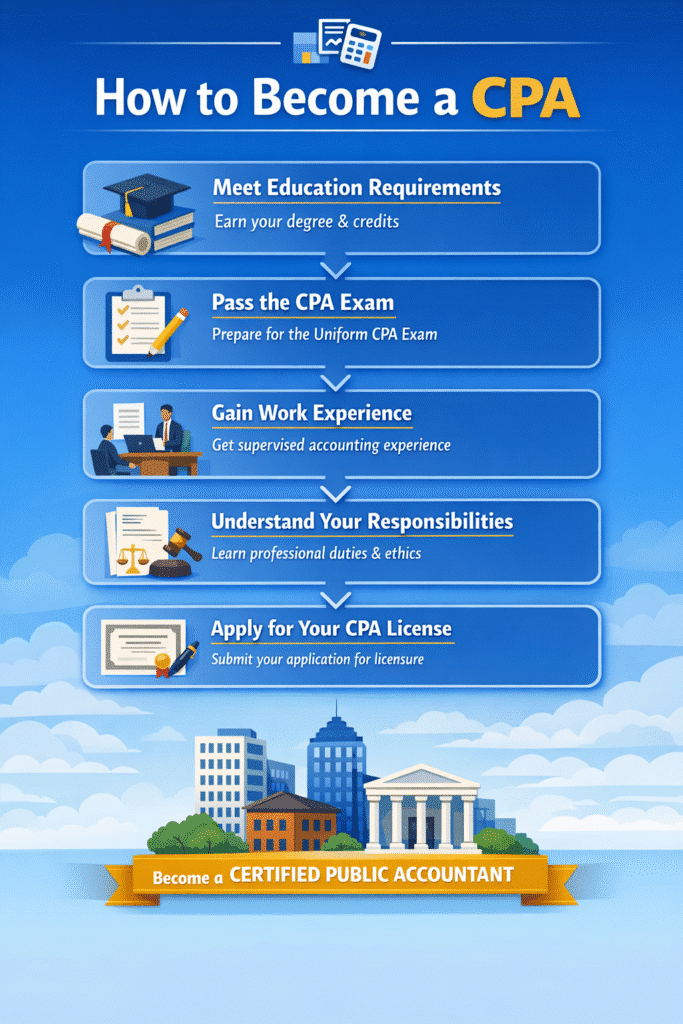
Step 4: Prepare for the Uniform CPA Exam
The Uniform CPA Exam is the biggest hurdle on the path to CPA certification. It tests real-world knowledge, covering complex accounting topics such as:
- Financial accounting
- Business analysis
- Information systems
- Tax and regulation topics
Most people use a CPA exam review course to stay organized and focused. These programs help break down the material and keep your study plan realistic.
Learn about the best CPA exam prep courses here.
Step 5: Pass All Four Exam Sections
You don’t have to pass all sections at once, but you do need to pass all of them within a set time window.
The exam tests your ability to:
- Interpret data
- Apply accounting rules
- Understand how businesses actually operate
This is where many people decide whether the CPA profession is right for them. It’s challenging, but it’s also fair if you prepare properly.
Step 6: Gain Relevant Work Experience
Passing the exam isn’t enough on its own.
To earn CPA licensure, you’ll need to gain work experience under a licensed supervisor. A public accounting firm is the most popular locale for this, but other roles may qualify depending on your state.
Experience may include:
- Audit or tax work
- Preparing reports
- Supporting attestation services
- Exposure to advisory services
This step is what turns exam knowledge into real-world skill.
Step 7: Understand Your Professional Responsibilities
Holding a CPA license comes with authority and accountability.
CPAs often work with sensitive information and may represent clients before tax authorities. Many follow the standards set by the American Institute of CPAs, which helps define professional standards and ethics.
You may also work on tax compliance, audits, or formal opinions relied on by investors and regulators.
Step 8: Apply for Your CPA License
Once your education, exam, and experience are all up to snuff, it’s time to apply for your CPA license.
The process typically includes:
- Verifying education and experience
- Submitting references
- Completing a criminal background check
Once approved, you become a licensed CPA and can legally use the CPA designation.
Conclusion
Becoming a CPA takes planning, patience, and follow-through—but as tough as the process is, it’s actually very simple. Just follow the steps. It’ll take some grit, but if you’re interested in finance, you probably already have some (and in good measure, too).
So, get started today. Before you know it, you’ll have the career of your dreams.
FAQs
Most people take four to six years, depending on how quickly they complete their education, exams, and work experience.
Not always. Some candidates use a master’s degree to reach the 150-credit requirement, but it isn’t mandatory in every state.
In many states, yes. Some allow you to sit for the exam before completing all required credits.
Often, but not always. Some states accept experience from industry, government, or other qualifying roles.
A CPA license allows you to sign reports, provide certain attestations, and represent clients in specific situations.
Save $629 Surgent CPA Ultimate Pass
See Details
Save Up to 25% On PM PrepCast Elite Plus Course Package
See Details

Take 15% Off UWorld CFA Level 3 Review Course
See Details
Get 15% Off UWorld CFA Level 2 Prep Course
See Details
Extended Sale – $160 Off Becker EA Exam Review Pro
See Details

Kaplan CAIA Review Course – 10% Savings
See Details
$210 Off CIA Challenge Exam Review – Essentials Package from Becker + The IIA
See Details
Kaplan CFA Premium Course – Enjoy 10% Off
See Details
Extended Sale – $195 Off CIA Premium Package From Becker + The IIA
See Details
Extended Sale – $320 Off CIA Pro Package From Becker + The IIA
See Details
Extended Sale – $131 Off Becker EA CE Subscription
See Details
Enjoy $715 Off Becker CPE Prime (2-Year)
See Details
See Details
Extended Sale – $990 Off Becker CMA Pro
See Details
Extended Sale – $1,000 Off Becker CPA Concierge
See Details

Save 20% on Surgent EA CE Course Package
See Details
Flash Sale – Take $500 Off UWorld CMA Elite-Unlimited Course
See Details
Extended Sale – $1,345 Off Becker CPA Pro
See Details
If you want to land a rewarding job at one of the big 4 accounting firms, you’re going to have to hit the books. The best way to ensure you become an asset so valuable that one of the big 4 has to hire you is to master everything there is to know about public accounting.
There’s just one problem: this process can be very expensive.
If you’re studying to become a CPA and taking it seriously, you’re going to need a CPA exam review course. Although they’re definitely worth the money, and many providers offer helpful financing options, the truth of the matter is that these courses don’t come cheap.