Acronyms are great to drop in a conversation where everyone’s “in the know,” but for the rest of us, they can be pretty confusing. So, naturally, a lot of people hear this term out in the wild and wonder:
What is a CPA?
Luckily, it’s pretty simple; a CPA is just a highly trusted type of accountant who’s earned a special title and a lot of responsibility. I’m going to walk you through what a CPA does, why it matters, and what a CPA career can actually be like.
Key Takeaways
- CPA = Certified Expert: A CPA is a licensed accountant who’s passed the CPA Exam, met education requirements, and earned serious trust.
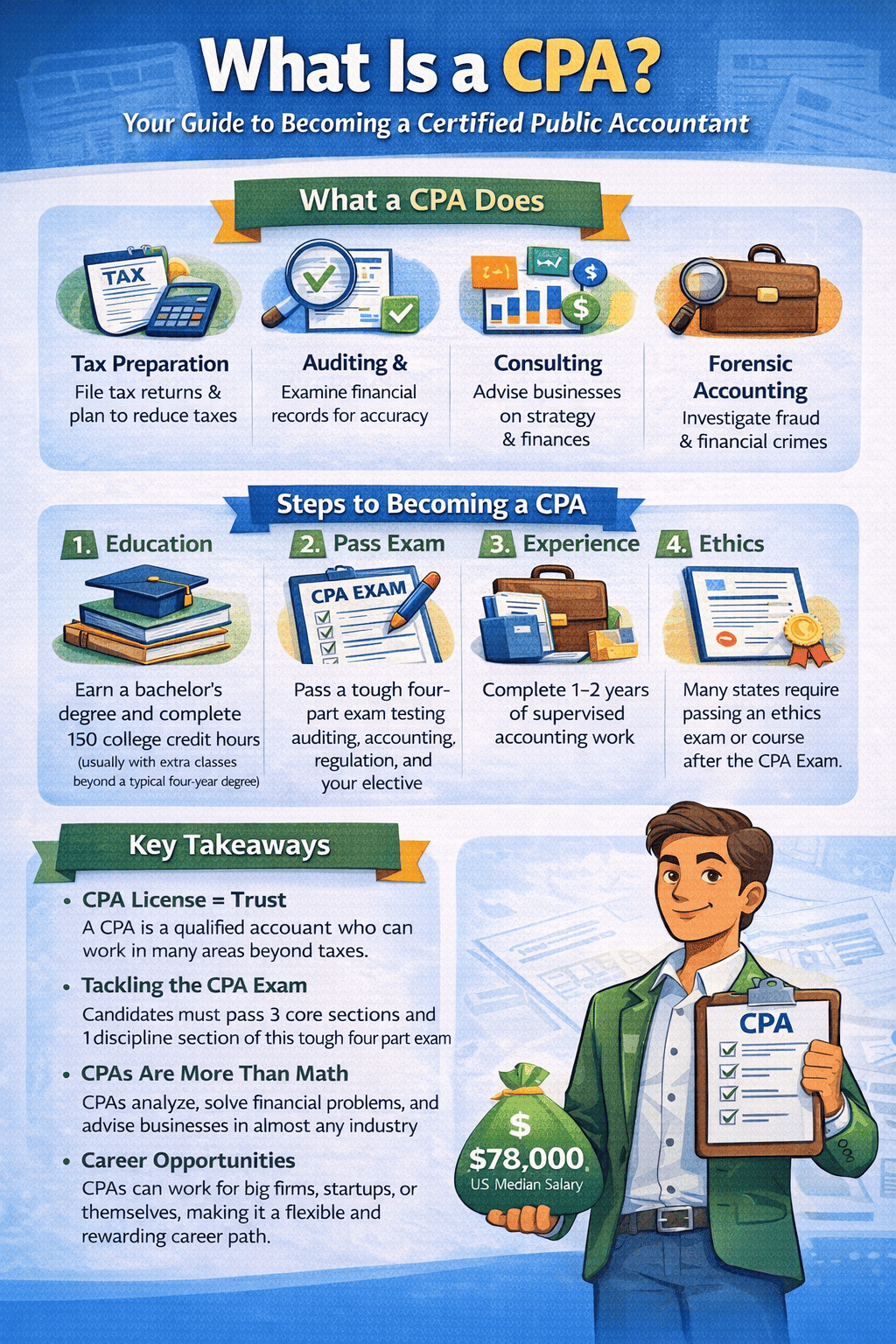
- Not Just Taxes: CPAs can work in auditing, consulting, forensic accounting, payroll, and even fraud investigation—not just tax prep.
- The CPA Exam Is No Joke: Getting certified means tackling a tough 4-part CPA exam, meeting education and experience rules, and staying current.
- You Don’t Need to Be a Math Genius: CPAs rely more on logic, rules, and analysis than advanced math; critical thinking matters more.
- Career Flexibility Is Huge: CPAs can work for firms, startups, or themselves, and in just about every industry that touches money (so… all of them).
So What Is a CPA, Really?
A CPA stands for Certified Public Accountant. That means two things right off the bat:
- They’re certified — proven they know their stuff.
- They’re public — licensed to work for you or businesses, not just inside one company.
If you picture someone who understands taxes, money, numbers, and financial rules better than most people, you’re starting to get the idea of a CPA. But there’s a lot more to it than filling out tax forms.
Many aspiring finance professionals want to know: Is this career worth it? What does the day‑to‑day actually look like? Is it stressful? These are real questions, and I’ll answer them in a way that actually makes sense.
The Basics: What a CPA Actually Does
Let’s break down the typical work a CPA might do:
Tax Preparation and Planning
- CPAs prepare tax returns for individuals and businesses.
- They help clients reduce what they owe legally.
- They make sure everything is filed correctly and on time.
Taxes can be confusing. If you’ve ever done your own tax return and thought, “Wait… what?”, a CPA is like the friend who finally explains it in plain English.
Auditing and Assurance
- CPAs can audit financial statements.
- That means they check if a company’s numbers are accurate.
- Banks, investors, and regulators care a lot about this.
Imagine a financial “health check” but for a business. That’s what audits are.
Consulting and Advisory
- CPAs give financial advice.
- They help with budgeting, planning, and decision‑making.
- They often work with business owners to grow profits and cut waste.
So a CPA doesn’t just look backward at taxes; they also look forward at strategy.
Forensic Accounting
- Some CPAs investigate financial wrongdoing.
- They might work on fraud cases or legal disputes.
- This is like being a detective with numbers.
It’s not as common as taxes or audits, but it’s a cool niche and well‑paid.
Payroll and Bookkeeping
- CPAs might help businesses manage payroll.
- They sometimes oversee day‑to‑day records before handing them off to specialists.
Smaller firms love CPAs because they can wear a lot of hats. Unfortunately, however, very small firms can take advantage of that, so CPAs have to be careful where they decide to work. Generally speaking, go for corporate over a “mom and pop shop.”
How Do You Become a CPA?
Here’s how someone earns that CPA letters after their name:
1. Education
You usually need a bachelor’s degree, often in accounting or finance. Most states require 150 college credit hours, which is a bit more than a typical 4‑year degree. Some people finish with a master’s to hit that requirement.
2. Exam
The CPA Exam is a big deal. It’s hard (with a pass rate as low as 37.64% in 2025) and has six sections, though students only have to take four.
Required, or “core” sections, include:
- AUD: Auditing and Attestation
- FAR: Financial Accounting and Reporting
- REG: Taxation and Regulation
Then, candidates choose one of the following discipline sections:
- BAR: Business Analysis and Reporting
- ISC: Information Systems and Control
- TCP: Tax Compliance and Planning
| CPA Exam Section Type | Section Code | Section Name |
|---|---|---|
| Core (Required) | AUD | Auditing and Attestation |
| Core (Required) | FAR | Financial Accounting and Reporting |
| Core (Required) | REG | Taxation and Regulation |
| Discipline (Choose One) | BAR | Business Analysis and Reporting |
| Discipline (Choose One) | ISC | Information Systems and Control |
| Discipline (Choose One) | TCP | Tax Compliance and Planning |
3. Experience
Almost every state says you need a year or two of supervised experience before you’re fully licensed.
4. Ethics
Many states require an ethics test or course. Because CPAs are trusted with money, ethics matter.
Once all that is done, congratulations; you’re a CPA.
Why People Choose to Become a CPA
So what’s the draw? Here are some of the biggest reasons people chase the CPA:
Career Stability
People and businesses always need financial help. Whether the economy booms or slows, someone’s got to do the numbers. As a result, becoming a CPA is one of the more stable options out there, even with the introduction of AI to the industry.
Good Pay
CPAs tend to earn more than non‑licensed accountants. The certification signals trust and skill, and employers pay for that. In part, it’s because clients want to see a CPA, and that means more business for the firm.
Wide Range of Work
You could:
- Do taxes part of the year and strategy the rest.
- Work in a big firm or start your own practice.
- Specialize in tech, healthcare, or fraud detection.
It’s flexible. You get to “choose your own adventure” based on your income goals, ideal work environment, and desired lifestyle.
Respect and Trust
Let’s be honest: people take CPAs seriously. If your title has “CPA” behind it, you’re not just “an accountant.” Instead, you’re THE person companies trust with financial decisions.
What Being a CPA Is Like Day‑to‑Day
Now, let’s dig into the reality:
Busy Seasons Exist
For most CPAs, tax season (January–April) is like Final Exam Season every day. Lots of hours and deadlines.
Client Work
You spend a lot of time asking questions like:
- “Can you explain this transaction?”
- “Do you have documentation for this expense?”
- “When did you receive this income?”
As a result, communication matters almost as much as accounting. Introverts may feel overwhelmed by the responsibilities, which often require regular meetings, phone calls, and digital correspondence.
Problem Solving
You don’t just plug numbers into a form; you interpret data. Why did this change? How does this affect new decisions moving forward?
Continuing Education
CPAs have to keep learning because the rules are constantly changing. If you don’t stay current, you don’t stay certified, and this requires some extra organization (and hours invested) on the CPA’s end.
Common Misconceptions About CPAs
Let’s clear up a few myths:
Myth: CPAs Only Do Taxes
Nope. Taxes are a big part, but they also audit, advise, and strategize.
Myth: CPAs Are Only for Rich People or Big Companies
Nope again. Individuals, small business owners, startups; all kinds of people use CPAs.
Myth: You Have to Be a Math Genius
Not really. You need to be comfortable with numbers and logic, but it’s not advanced calculus. It’s more about understanding rules and applying them.
Who Should Consider Becoming a CPA?
Becoming a CPA isn’t for everyone — but here’s who it does make sense for:
- You like structure and rules.
- You enjoy solving puzzles (even financial ones).
- You communicate well with clients and teams.
- You want a role that blends numbers with business decisions.
- You want a credential that opens doors in finance and accounting.
If you love accounting but also like working with real people and solving real problems, being a CPA could be a great fit.
Conclusion: Is Being a CPA Worth It?
Being a CPA feels like having a backstage pass to the financial world. You get to see how businesses operate, help people reach goals, and be the person others rely on when the numbers matter.
It’s not always easy (the exam is tough and the work can be intense), but for many, that challenge is part of the appeal. If you like structured problem‑solving, want a career you can build on, and enjoy helping others make smart choices with their money, becoming a CPA could be one of the best decisions you make.
Ready to get started? Learn the steps to becoming a CPA and check out the top CPA review courses.
FAQs
CPA stands for Certified Public Accountant. It’s a license that shows an accountant has met strict education, exam, and experience standards.
Nope. Many CPAs specialize in audits, consulting, financial strategy, fraud investigations, and other areas beyond just tax preparation.
Yes, most people find it challenging. It has four parts, takes serious studying, and often requires multiple tries to pass all sections.
It’s possible, but you’ll still need to meet specific education requirements — usually 150 college credit hours with core accounting courses.
It typically takes around 5–7 years total, including college, passing the exam, and completing the required work experience.