Choosing between the CPA vs. CMA isn’t about which credential sounds more impressive; it’s about where you want your career to go.
Both the Certified Public Accountant (CPA) and the Certified Management Accountant (CMA) are respected accounting certifications, but they lead to different roles, responsibilities, and long-term career paths.
If you’re trying to decide which certification fits your goals, this guide will walk you through the differences in education, exams, salary potential, and job opportunities so you can make a confident choice.
Key Takeaways

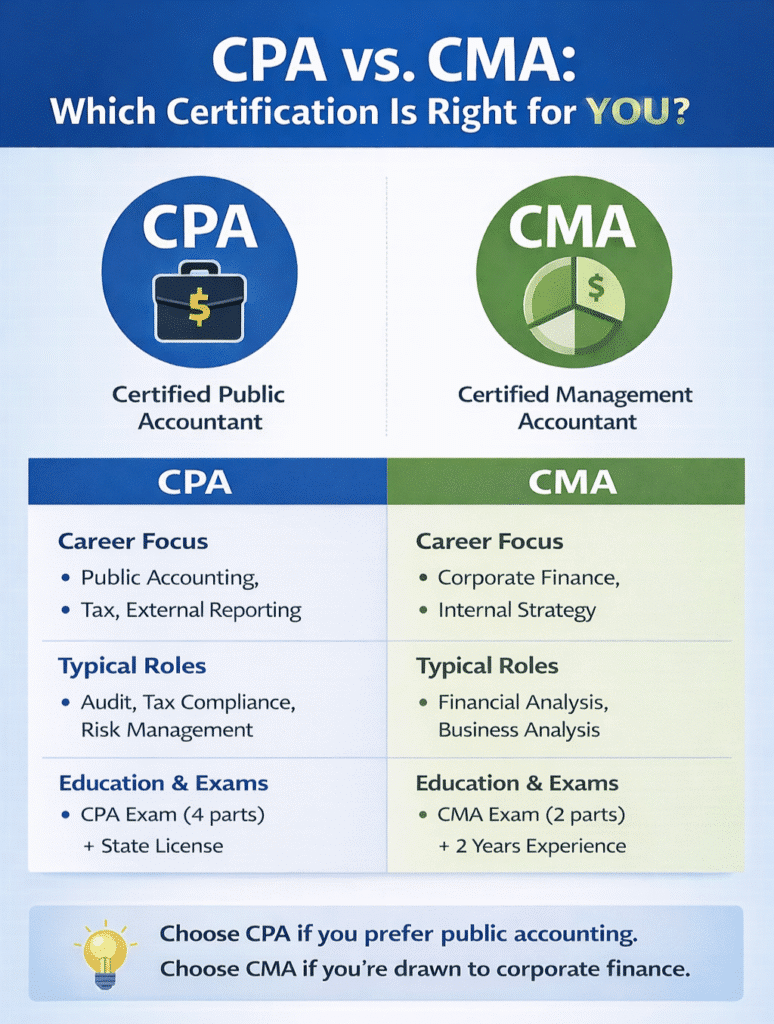
- Different Career Tracks: The CPA certification is geared toward public accounting and external reporting, while the CMA certification focuses on corporate finance and internal strategy.
- Licensure vs. Credential: A CPA license is state-issued and legally required for certain roles, whereas the CMA is a globally recognized management accounting credential.
- Exam Focus Matters: The CPA exam emphasizes auditing, tax compliance, and financial reporting, while the CMA exams center on financial management and performance analysis.
- Salary Growth Potential: Both credentials can increase average salary potential, but outcomes depend on your industry, role, and experience level.
- Your Goals Should Lead: The right choice depends on whether you want to work with external clients and regulators or guide internal business decisions.
CPA vs. CMA: Which Certification Is Right for You?
Earn a CPA if you plan to work in audit, tax, or public accounting, where a state license is legally required; choose the CMA if your goal is to lead internal financial strategy and management within a company.
The CPA unlocks roles that interface with regulators and external clients, while the CMA positions you for strategic finance roles inside corporate environments.
What Is a CPA?
The CPA credential is designed for professionals working in public accounting, auditing, tax compliance, and external financial reporting. CPAs are licensed by state boards, and the CPA license allows you to sign audit reports and represent clients before the IRS.
Common CPA Career Paths
- Public accounting (audit and tax)
- External financial reporting
- Risk management
- Financial statement analysis
- Corporate accounting leadership
- Financial planning and advisory
If you see yourself working in public accounting firms, preparing or reviewing financial reporting for public companies, or specializing in tax compliance, the CPA certification is typically the gold standard.
What Is a CMA?
The CMA credential focuses on internal finance roles within organizations. The designation emphasizes strategic management, corporate finance, and performance management rather than audit or public reporting.
Common CMA Career Paths
- Corporate finance leadership
- Financial analysis
- Business analysis
- Financial management
- Cost accounting
- Strategic planning roles
If you’re drawn to a management accounting career inside a company rather than serving external clients, the CMA certification may align better with your goals.
Education and Requirements
Both certifications require a bachelor’s degree, typically in accounting or a related field. Many candidates also hold an accounting degree, although other business degrees may qualify depending on the credential.
CPA Requirements
CPA requirements vary by state, but generally include:
- 150 college credit hours
- Passing all sections of the CPA exam
- Relevant work experience under a licensed CPA
- Meeting ethics requirements
Because the CPA is a state-issued license, requirements can differ slightly depending on where you apply.
CMA Requirements
To earn the CMA certification, candidates must fulfill these requirements:
- Hold a bachelor’s degree
- Pass both the CMA exams
- Complete two years of relevant professional experience in the field
The CMA is administered globally and does not involve state licensing.
CPA and CMA Exams Compared
The CPA and CMA exams test different skill sets.
The CPA exam covers financial accounting, auditing, tax compliance, and regulatory topics. It’s comprehensive and designed to prepare professionals for public accounting and financial reporting roles. A top CPA review course will help prepare you for the exam.
The CMA exams focus on financial management, corporate finance, performance management, risk management, and strategic management. The emphasis is on internal decision-making and business analysis. CMA study materials are recommended to help you pass, particularly those that have been updated to reflect the
If you prefer structured rules, external reporting standards, and technical accounting, the CPA exam may feel more natural. If you enjoy financial analysis, forecasting, and helping businesses make strategic decisions, the CMA exams may be a better fit.
Salary Expectations
When comparing average salary outcomes, both credentials can significantly increase earning potential.
- The average salary for a CPA in the U.S. often ranges from $70,000 to well over $120,000, depending on experience, role, and location. Senior roles can earn substantially more.
- CMAs frequently report salaries that exceed non-certified peers, particularly in corporate finance and leadership positions. CMA holders earn $105,000 on average, via ZipRecruiter.
In many cases, both the CPA and CMA offer strong salary growth. The difference usually comes down to the industry and the type of role you pursue.
Work Environment Differences
CPA: Public and External Focus
A licensed CPA often works with clients, regulators, and external stakeholders. Responsibilities include:
- Tax compliance
- Financial reporting
- External financial reporting decisions
- Audit engagements
Public accounting firms are common entry points, though many CPAs transition into corporate leadership roles later.
CMA: Internal and Strategic Focus
The CMA certification centers on:
- Corporate finance
- Financial planning
- Performance management
- Strategic management
- Risk management
CMAs typically work inside organizations, helping leadership interpret data and guide business decisions.
Exam Fees and Cost Considerations
Exam fees vary by certification and membership status. The CPA certification can be more expensive overall due to application fees, state licensing costs, and more exam sections. CMA exam fees are typically bundled into two exam parts plus membership dues.
Both require continuing education to maintain certification, so ongoing costs should also factor into your decision.
Can You Earn Both?
Some accounting professionals pursue both the CPA and CMA to broaden their expertise. Having both credentials can be especially powerful in corporate leadership roles that require deep financial accounting knowledge and strong financial management skills.
However, earning both requires significant time, exam preparation, and financial investment. It’s often smarter to start with the certification that best aligns with your immediate career goals.
How to Decide: Questions to Ask Yourself
- Do I want to work in public accounting or corporate finance?
- Am I more interested in financial reporting or business analysis?
- Do I want a state-issued CPA license?
- Do I see myself advising clients externally or guiding strategy internally?
- Which subject matter feels more engaging: tax compliance and auditing, or performance management and financial analysis?
Your answers will likely point clearly toward one certification.
Final Thoughts
The CPA certification is great for professionals pursuing public accounting, audit, and external financial reporting roles. The CMA certification is better suited for those focused on corporate finance, strategic management, and internal financial leadership.
Neither is “better” universally. The right choice depends entirely on your preferred career paths, strengths, and long-term goals. When you align your certification with the work you actually want to do, you’re far more likely to stay motivated, advance quickly, and build a career that feels intentional rather than accidental.
FAQs
Both the CPA and CMA exams are challenging, but they test different knowledge and skills. The CPA exam covers more sections and regulatory content, while the CMA exams focus more on financial management and analysis.
Yes, some accounting professionals pursue both certifications to broaden their expertise. However, earning both requires significant time, exam fees, and ongoing effort to maintain certification.
Both credentials can lead to strong earning potential. CPAs often earn more in public accounting and audit roles, while CMAs may command higher salaries in corporate finance and management positions.
Both certifications require a bachelor’s degree, and many candidates hold an accounting degree. However, specific education requirements vary depending on state CPA requirements or CMA eligibility standards.
The CMA certification is generally better aligned with corporate finance, strategic management, and internal financial planning roles.