If you’re considering becoming a CMA, salaries are probably one of the first things on your mind and frankly, they should be. The Certified Management Accountant credential takes time, effort, and serious study (to the tune of ~300 hours, via the IMA). You want to know if it’s worth it, and as a finance aficionado, chances are, you’re concerned about that ROI.
The short answer?
CMAs often earn more than non-certified accountants, especially as they move into leadership roles. That said, salary depends on experience, location, industry, and how you use the credential, so it isn’t the perfect fit for everyone.
Let’s break it down clearly so you know what to expect.
Key Takeaways
- CMA Salaries Are Strong: The average CMA salary is $133,000, with median pay at $122,000.
- Total Compensation Is Even Higher: Average total compensation reaches $158,000, with a median of $135,000.
- Certification Pays Off: CMA holders earn about 24% more in salary and 27% more in total compensation than non-holders.
- Some Industries Are More Lucrative: Industries like manufacturing, technology, and healthcare can be more lucrative than others.
- More Experience, Higher Pay: Naturally, the longer you work and the more experience you earn translates to a higher salary over time.
What Is the Average CMA Salary?
Let’s talk numbers. Here are some of the key facts to know, sourced from the IMA’s USA Salary Survey.
- $133,000 average salary ($122,000 median)
- $158,000 average total compensation ($135,000 median)
- CMA holders earn a 24% higher salary than non-holders on average
- This increases to 27% for total compensation
Here’s a look at how different certifications (or lack thereof) can affect your income as a management accountant:
| Certifications | Mean Salary (% Increase) | Median Salary (% Increase) |
|---|---|---|
| Neither CMA Nor CPA | $109k | $100k |
| CMA Only | $136k (25%) | $124k (24%) |
| CMA and CPA | $151k (39%) | $139k (39%) |
The big takeaway: the credential often accelerates earning potential, especially in corporate finance environments. For an even bigger salary boost, consider earning both the CPA and CMA designations.
Entry-Level CMA Salary
If you’re just starting out, your salary will likely depend more on your role than the letters after your name.
Common entry-level roles include:
- Staff accountant
- Financial analyst
- Cost accountant
- Junior financial analyst
At this stage, the CMA designation signals ambition and technical strength. It may not instantly double your pay, but it can:
- Help you stand out in hiring
- Support faster promotions
- Strengthen salary negotiations
Early-career CMAs often earn more than peers over time because they move up more quickly.
Mid-Career and Senior-Level Earnings
This is where the CMA credential really starts to show its value.
Mid-career professionals with a CMA often move into roles like:
- Finance manager
- Senior financial analyst
- Corporate controller
- Director of Finance
At this level, compensation often crosses into six figures, especially in larger organizations or high-cost markets.
Senior-level CMAs can move into executive roles such as:
- VP of Finance
- CFO
- Strategic finance leader
At this point, compensation may include bonuses, equity, and performance incentives — not just base salary.
How Industry Affects CMA Salary
Not all industries pay the same.
CMAs working in the following fields often outearn those in small, private firms and/or nonprofit positions:
- Manufacturing
- Technology
- Healthcare
- Financial services
Corporate environments that rely heavily on cost analysis, budgeting, forecasting, and internal strategy tend to value the CMA skill set more directly.
The credential is especially aligned with internal decision-making roles, not public accounting.
Location Matters (A Lot)
Geography plays a significant role in compensation.
Major metropolitan areas generally offer higher salaries. However, higher pay often comes with higher living costs.
In smaller markets, salaries may be lower, but your purchasing power can be comparable or even better.
If you’re flexible about relocation, that can expand your earning ceiling.
Salary vs. CPA: How Do They Compare?
This question comes up often.
CPAs are typically associated with public accounting, audit, and tax. CMAs focus more on corporate finance, planning, and performance management.
In many corporate settings, CMA salaries are competitive with CPA salaries, especially in management roles. In public accounting firms, CPAs often have a clearer advantage.
If your goal is corporate leadership, the CMA can be just as financially rewarding.
Does the CMA Actually Increase Your Salary?
Research and industry surveys consistently show that professionals with the CMA credential earn more on average than non-certified peers.
But here’s the nuance.
The credential doesn’t magically raise your paycheck overnight. What it does is:
- Expand your skill set
- Increase your credibility
- Open doors to higher-level roles
The salary increase usually comes through promotion and responsibility, not an automatic bump.
Long-Term Earning Potential
The real value of the CMA isn’t just your first job after passing the exams. It’s the long-term trajectory.
CMAs are trained in:
- Financial planning
- Strategic analysis
- Cost management
- Decision support
Those skills translate directly into leadership roles. And leadership roles are where compensation climbs fastest.
If you plan to stay in corporate finance long term, the CMA can meaningfully increase your lifetime earnings.
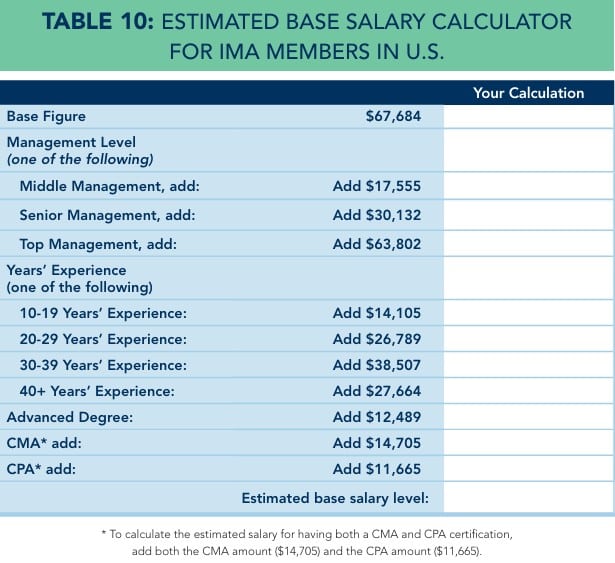
CMA Salary Calculator
Final Thoughts
CMA salaries are generally strong, especially as you gain experience and move into management. Early on, the pay difference may be modest. Over time, it often becomes significant.
If your goal is to work inside organizations, influence financial decisions, and grow into leadership, the CMA can be both professionally and financially rewarding. Like most credentials, it’s not a shortcut. But for the right career path, it can absolutely pay off.
FAQs
The average CMA salary is about $133,000, with total compensation averaging around $158,000 when bonuses and incentives are included.
Yes. On average, CMA holders earn about 24% more in base salary and 27% more in total compensation than professionals without certification.
Professionals holding both credentials earn around $151,000 on average, which is roughly 39% higher than those with neither certification.
The gap may start modestly, but it often widens over time as CMAs move into management and strategic finance roles.
Yes. Average total compensation ($158,000) is significantly higher than base salary alone ($133,000), reflecting bonuses and performance incentives.