
AnalystPrep CFA® Review: Who It’s Really Built For

The CFA® exams are known for low pass rates, especially at Level I and Level II. That alone makes choosing the right prep provider more important than most candidates realize.
The difference between passing and retaking often comes down to how well your study materials match your learning style and exam strategy.
As an exam prep reviewer, I tested AnalystPrep’s CFA® course firsthand to evaluate how it handles question bank depth, mock exams, video lessons, and overall exam preparation. In this review, I break down where AnalystPrep stands, who it fits best, and whether it supports serious CFA® goals across all three levels.
Will AnalystPrep CFA® Fit Your Learning Style?
- Do you want to spend most sessions in practice mode? Most of your time will be spent in the question bank and mock exams.
- Do you need very detailed answer explanations? Explanations explain the logic, but they are not extremely in-depth.
- Do you study best with a defined structure? Content is clearly organized by level and topic, but pacing is self-directed.
- Are you aiming for steady understanding? Lessons and practice are designed to build concepts progressively.
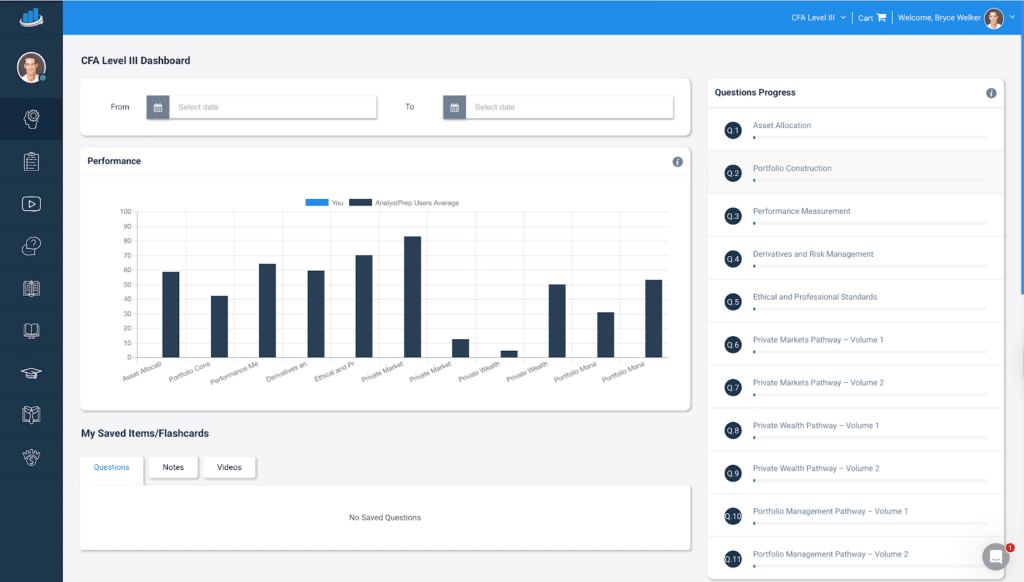
- Do you like tracking performance as you go? The dashboard highlights strengths and weaker areas so you can adjust focus.
AnalystPrep CFA® Review: My Prep Experience

Before diving in, it’s worth noting that I’ve worked inside a lot of prep platforms over the years — CPA, CMA, and multiple CFA providers. I’ve seen highly structured programs, massive lecture libraries, and question banks that either overwhelm you or underprepare you. So when I test a course, I’m looking for flow, clarity, and whether the system actually supports long-term retention, not just surface-level exposure.
Once I got inside the platform, I started in the question bank, ran a short quiz, reviewed the explanations, and then opened a video lesson to tighten up the weak spot. The practice-and-reinforcement cycle of AnalystPrep CFA® felt easy to repeat, which matters when you’re studying for something this long.
The structure stays consistent across plans. Question banks, CBT mock exams, printable versions, study notes, and video lessons are organized clearly by Level I, II, and III. If you’re on the Unlimited plan, you can move between levels without switching platforms, which keeps everything centralized.
The CBT mock format feels close to real exam pacing, so timing practice feels practical. The videos are straightforward and curriculum-aligned, focused on explaining concepts clearly.
What it doesn’t do is enforce structure. You see your performance data, but you still decide what to tackle next. If you prefer being told exactly what to fix after a mock, that guidance isn’t automatic. Navigation can also feel slightly click-heavy when switching between content types, though it’s not disruptive.
AnalystPrep CFA® Package Options
- Practice Package: You get the single level-specific question bank, five full-length mock exams, and the analytics dashboard with 12 months of access. It is a focused drill-and-review setup without the lesson layer.
➡️ Best for students who already have notes and want more exam-style reps - Learn + Practice: This adds study notes, the full video library, formula sheets, and instructor support for that level. It lets you learn a concept and immediately test it.
➡️ Best for students who like lessons first, then practice right away - Unlimited Package: One-time payment for full access across Levels I, II, and III, including curriculum updates and Ask-A-Tutor questions.
➡️ Best for students who want unlimited access across multiple CFA® levels
AnalystPrep Package Comparison Table
| Feature | Practice Package | Learn + Practice | Unlimited Package |
|---|---|---|---|
| Price | $349 | ~$499 | ~$799 |
| Question Bank |  Full access (Level-specific) | Full access (Level-specific) | Full access (Levels I, II, III) |
| Mock Exams | Included | Included | Included (All Levels) |
| CBT + Printable Mock Format | | | |
| Video Lessons |  | | |
| Study Notes | | | |
| Formula Sheets | | | |
| Performance Analytics | | | |
| Live Chat with Instructors | | | |
| Ask-A-Tutor Questions | | Limited (varies) | Unlimited |
| Access Length | 12 months | 12 months or Lifetime (varies by level) | Lifetime |
| Multi-Level Access | Single Level | Single Level | Levels I, II, III |
| Curriculum Updates Included | | | |
| Get Started | GET PRACTICE PACKAGE | GET LEARN + PRACTICE | GET UNLIMITED PACKAGE |
AnalystPrep Discounts

AnalystPrep CFA® Package Perks
- Question banks across all levels with customizable quizzes
- Full-length CBT printable mock exams
- Video lessons organized by curriculum
- Concise study notes for fast topic review
- Formula sheets for last-minute reinforcement
- Performance dashboard to track weak areas
- Ask-A-Tutor access on select plans
- Live instructor chat on select plans
- Annual curriculum updates
- Multi-device access
Pros
-
Practice-Forward Flow: I could jump into quizzes quickly and learn through review
-
Mocks Feel Familiar: The CBT format plus printable PDFs made it easy to simulate a test day
-
Clear Video Teaching: Good for resetting a concept without getting lost in a lecture marathon
-
All Levels Access at Once: The Unlimited plan gives Level I–III access without switching platforms
Cons
-
Self-Paced Means Self-Managed: If you need accountability, it can feel a little too open
-
Post-Mock Guidance Could Be Smarter: I wanted more “do this next” direction after a full exam
Closer Look at AnalystPrep CFA®: Platform, Practice, and User Feedback
Tech And Usability
I moved around the dashboard to see how quickly I could switch between quizzes, videos, and notes. Overall, it’s clean and loads fast, especially in CBT mock mode. The mobile app is great for those who use their phone more than a desktop. Building quizzes is simple, and I didn’t run into lag during timed sessions. It can feel slightly click-heavy when jumping sections, but nothing disruptive.
- Clean, distraction-free dashboard
- Fast quiz builder + CBT mock interface
- Multi-device access
Practice Question Quality
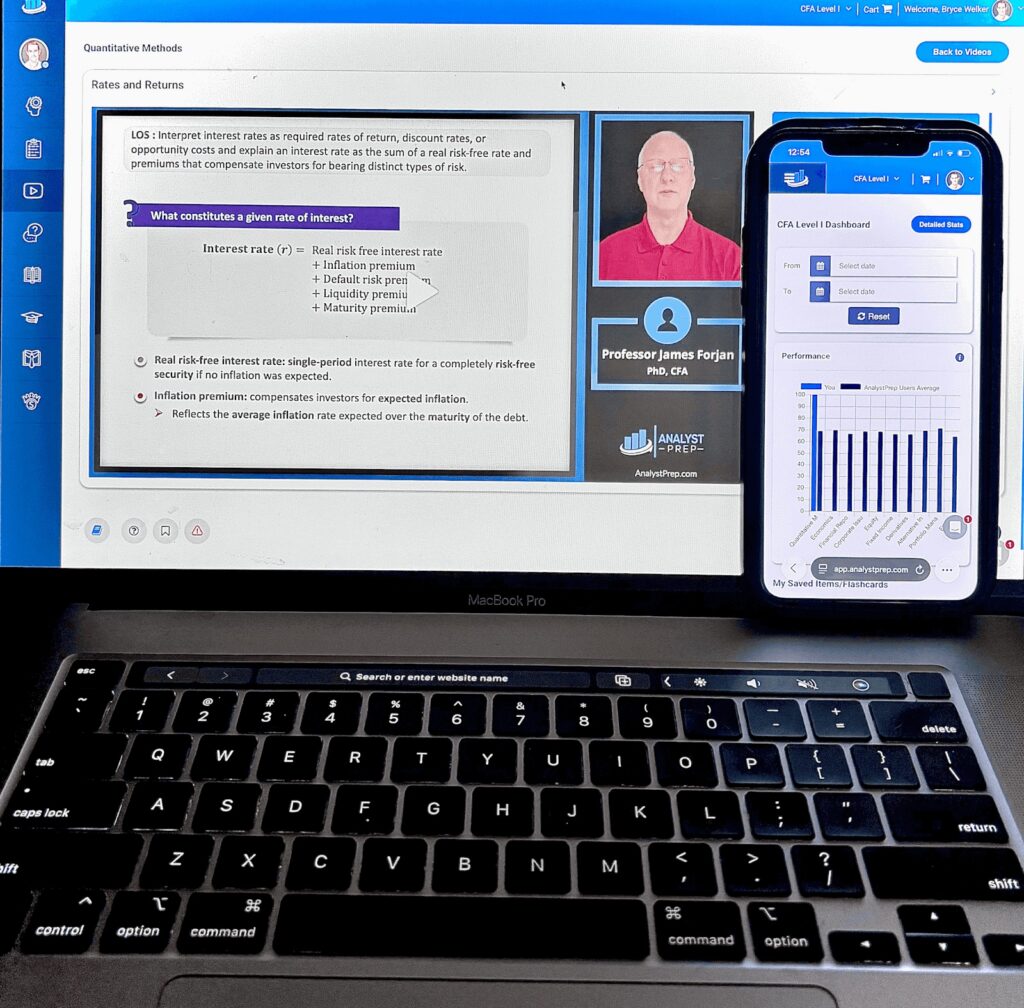
I built short quizzes across heavier topics like FRA and Fixed Income to test both depth and variety. I wanted to see whether the questions felt repetitive or whether they required real application. Overall, the wording felt consistent with CFA-style phrasing, especially at Level II, where the vignette-based item sets reflected the structure and pacing of the actual exam.
The Level II item sets required careful reading and multi-step thinking. I had to interpret the scenario, identify what was being asked, and apply the correct framework or formula. That kind of active problem-solving is important for CFA prep, and AnalystPrep handled it well.
The explanations were generally clear and logical. In most cases, I understood not only why the correct answer worked but also why the other options were wrong. Occasionally, I wanted more pattern-based reinforcement, such as a few additional similar problems in a row, to fully solidify the concept before moving on.
- 3,000+ Level I questions
- Level II vignette-style item sets
- Detailed answer explanations
Mock Exam Realism
When it comes to CFA® study, mock exams are key. I ran a full mock in CBT mode to test pacing and stamina. Although I liked the online version, I also found the printable PDF option to be useful for offline practice. The experience feels realistic, but post-mock analysis requires you to decide your next moves manually.
- Full-length CBT-format mocks
- Printable PDF versions
- Timed exam simulation
Instructor And Video Lessons
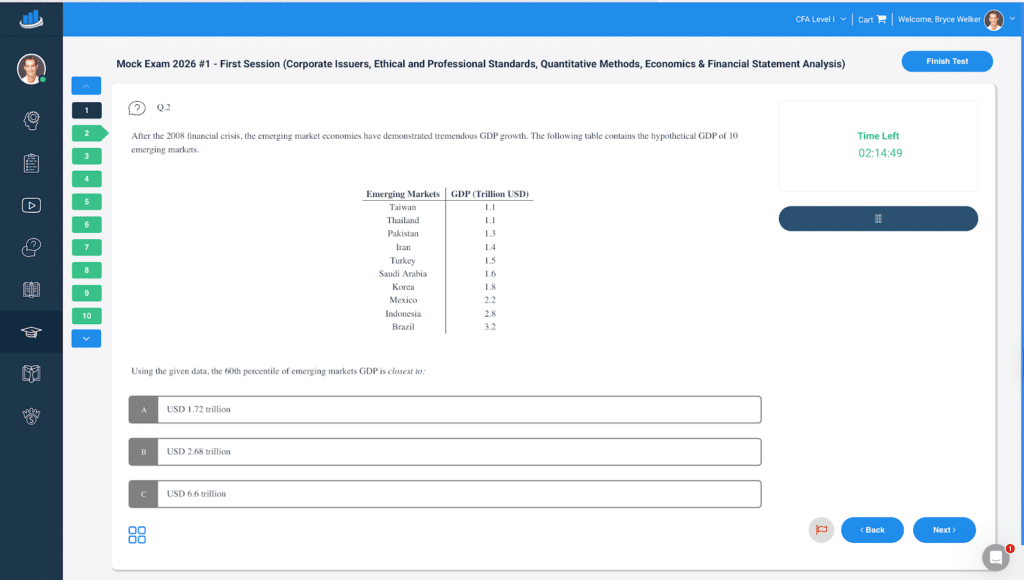
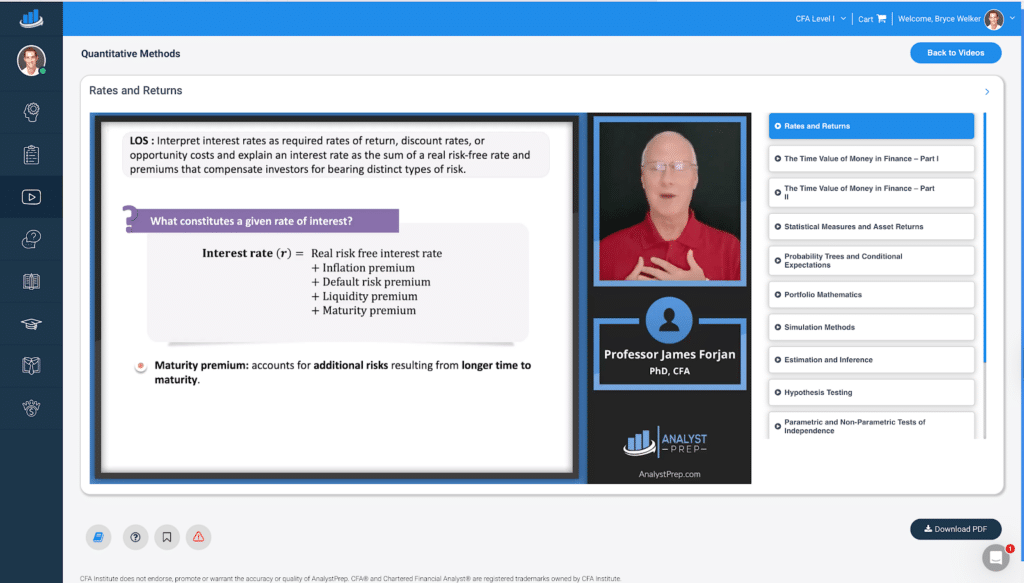
I sampled some of the tougher topics through Professor Forjan’s videos to see whether the teaching held up when the material got dense. It did. His explanations are structured, curriculum-aligned, and focused on helping you reset the concept when something isn’t clicking.
His style isn’t high-energy or overly animated, but that’s part of the strength. He teaches in a calm, direct way that feels grounded in experience. You get the sense quickly that he knows the material inside and out. The explanations are sharp and to the point, without unnecessary filler.
What stood out to me most was the clarity. He doesn’t overcomplicate ideas to sound impressive. Instead, he breaks them down in a way that feels accessible and steady, which is exactly what you want when working through complex Level I material. There’s also a subtle, dry sense of humor at times that makes longer sessions easier to stick with.
For candidates who want curriculum-focused walkthroughs and professor-led instruction that feels seasoned rather than flashy, this approach works well.
- 50+ hours of Level I video lessons
- Curriculum-mapped walkthroughs
- Professor-led instruction
Moving Up Levels (1 → 2 → 3)
I looked at how the platform scales across levels. Level I focuses on repetition and foundation-building, while Level II shifts properly into vignette application. The Unlimited package keeps access consistent across levels, which helps if you don’t want to switch providers mid-program.
- Full Level I–III access (Unlimited plan)
- Level II item-set focus
- Ongoing curriculum updates
Data And Progress Tracking
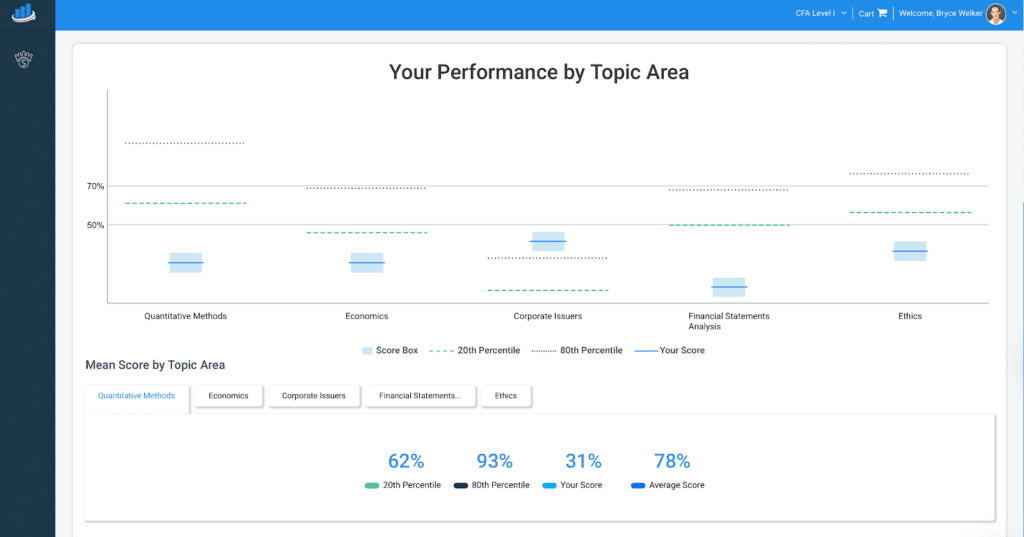
I spent time reviewing how the dashboard handles performance data after quizzes and mock exams. You get clear breakdowns by topic, overall score tracking, and visibility into weaker areas across all levels. It is easy to see patterns if you are consistently missing certain concepts.
The platform tracks quiz history and mock results, which helps when revisiting problem areas. It does not automatically generate a daily study plan, but it gives enough data to guide your decisions.
- Topic-by-topic performance breakdown
- Mock exam score tracking
- Weak-area identification
- Quiz history and progress visibility
Access, Guarantees, And Overall Value
Level-specific plans include 12 months of access, which is typically enough time for candidates moving steadily through a single exam level. The Unlimited package provides lifetime access across Levels I, II, and III, along with ongoing curriculum updates. For candidates planning to complete all three levels over several years, that long-term access can reduce the pressure of strict timelines.
There is no formal pass guarantee. Instead of positioning value around refund promises, AnalystPrep leans into content volume and longevity. The strength of the package comes from the size of the question bank, full-length mock exams, and the ability to revisit material without worrying about expiration.
From my perspective, the value here is best suited for self-directed candidates who want extended access and plenty of practice opportunities, rather than those looking for a structured program tied to a pass-or-refund policy.
Comparing AnalystPrep to Other CFA® Prep Courses
See how AnalystPrep stacks up against other providers below, or dive deeper into this comparison of the best CFA® study materials.
UWorld vs. AnalystPrep CFA®
UWorld CFA® is intense about explanations. Every question feels like a mini lesson. The breakdowns go deep into why the wrong answers are wrong, not just why the right one works. If you learn by picking apart mistakes and understanding logic step-by-step, this style hits.
AnalystPrep is more about volume and rhythm. The question bank is straightforward, and the CBT mock exams make it easy to stay in exam mode. The videos feel supportive, not central. It’s less about dissecting every answer and more about building reps.
Bottom Line:
→ Pick UWorld if you want deep answer analysis and strong performance diagnostics.
→ Pick AnalystPrep if you want steady repetition and realistic mock exam flow.
Kaplan Schweser vs. AnalystPrep CFA®
Kaplan CFA® leans into structure. Their programs often run 15–20 week study calendars with built-in checkpoints and live class options. When I explored it, it felt like someone else was pacing my prep for me.
AnalystPrep is more independent. You move between questions, videos, and mocks on your own timeline. It’s more self-directed and practice-centered. No heavy milestone system, just consistent access and repetition.
Bottom Line:
→ Pick Kaplan if you want structure and guided progression.
→ Pick AnalystPrep if you want flexibility and a straightforward practice engine.
Mark Meldrum vs. AnalystPrep CFA®
Mark Meldrum has an academic classroom feel. Some levels include 40+ hours of lecture-focused content, and the experience feels closer to a finance class than a drill platform. When I tested it, I spent more time learning concepts before jumping into practice.
AnalystPrep is more streamlined. My practice started earlier, and the question bank plus CBT-style mocks drive most sessions. It’s less layered and easy to keep moving through.
Bottom Line:
→ Pick Mark Meldrum if you prefer long-form conceptual lectures.
→ Pick AnalystPrep if you want a straightforward, practice-centered routine
My Final Verdict
AnalystPrep works best for self-driven CFA® candidates who learn by doing, especially if you want a clean routine that mixes videos, practice, and mocks without extra fluff. When I tested the platform, it was easy to jump into. I liked being able to move from a lesson to questions to a mock without overcomplicating my study sessions.
If you want deeper answer breakdowns and more intense question analytics, something like UWorld might feel stronger. If you need a strict study calendar and built-in structure, Kaplan could be a better fit. Still, AnalystPrep gives you the tools, but you are responsible for using them well. If you stay consistent, it absolutely supports steady progress.
FAQs
It does. The video lectures are taught by Professor James Forjan and walk through the curriculum in a clear, structured way. They’re designed to reinforce concepts before you jump into practice.
It’s one of the platform’s biggest strengths. You get exam-style questions across Levels I, II, and III, and the explanations are detailed enough to help you understand why an answer works, not just memorize it.
The Unlimited package includes lifetime access across all three levels. Other packages typically run on 12-month access, so it depends on which option you choose.
Yes, especially if you’re comfortable with vignette-style practice. The Level II content focuses on application and item sets, which mirrors how the actual exam is structured.
There aren’t traditional scheduled live classes, but their higher packages include live chat with instructors and Ask-A-Tutor questions. It’s still primarily self-paced, just with support available when you need it.