
How to Become a CMA: Full Certification Breakdown

If you want to move into higher-level financial and strategic decision-making, I’ve found the Certified Management Accountant (CMA) designation is one of the clearest ways to show expertise.
The Certified Management Accountant credential is issued by the Institute of Management Accountants. It focuses on management accounting and strategic financial management, not bookkeeping.
As an exam and prep course reviewer, I’ve seen that many candidates are eager to understand the requirements and exam structure, and with the right guidance, it becomes much clearer.
In this certification guide, I will break down exactly how to become a CMA, including the education requirements, experience requirements, CMA exam structure, and what happens after passing the CMA.

Key Takeaways
- IMA Membership Required: You must join the Institute of Management Accountants before starting the CMA program.
- Education Flexibility: A bachelor’s degree or approved professional certifications qualify.
- Two Years of Experience: You need real work in management accounting or financial management.
- Two-Part Exam: The CMA exam includes multiple-choice questions and case study scenarios.
- Ongoing CPE: You must complete 30 continuing education hours every year.
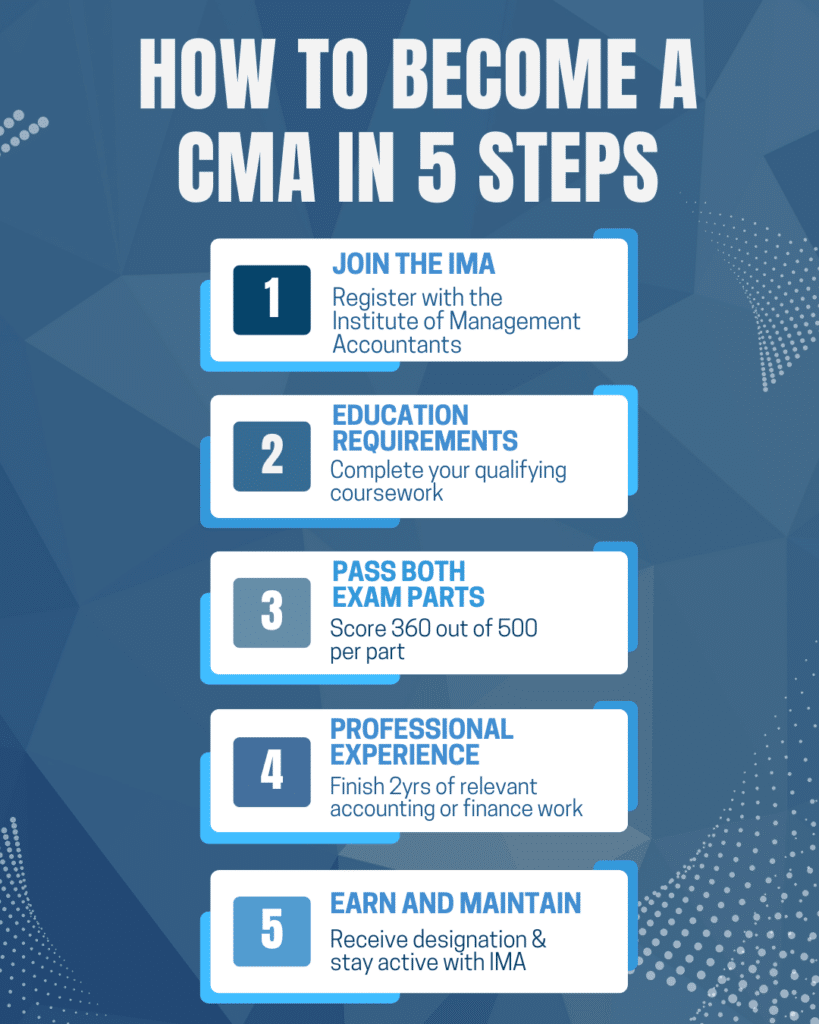
Step 1: Join the IMA
Before you can take the CMA certification exam, you must become an IMA member.
This includes:
- Paying the membership fee
- Enrolling in the CMA program
- Agreeing to follow IMA’s professional ethics standards
IMA membership is required for the entire time you are completing the program.
Step 2: Meet the Education Requirements
To become a certified management accountant, you must meet one of the official education requirements:
- Get a bachelor’s degree from an accredited college or university
- Hold one of the approved professional certifications recognized by IMA
You can take the CMA exam before finishing your degree. However, you must submit verification of your education within seven years of passing the exam. That seven-year window gives candidates flexibility while completing school or gaining experience.
Step 3: Enroll and Take the CMA Exam
The CMA exam has two separate parts:
- Part 1: Financial Planning, Performance, and Analytics
- Part 2: Strategic Financial Management
Each Part Includes:
- 100 multiple-choice questions
- 2 case-based question sets
- 4 hours total testing time
Key Facts:
- You must answer at least 50% of the MCQs correctly to unlock the CBQs
- Passing score: 360 out of 500 per part
- Results released: About 6 weeks after the testing window
Step 4: Complete the Experience Requirements
Passing the CMA exam is not enough by itself. To become CMA certified, you must complete two continuous years of professional experience in:
- Management accounting
- Financial management
Qualifying Experience Includes:
- Budgeting
- Cost analysis
- Financial reporting
- Forecasting
- Internal decision support
Internships and clerical roles do not count. The work must involve professional-level financial responsibility. You can fulfill the two-year professional experience requirement either before taking the CMA exams or anytime within seven years after passing them.
Step 5: Maintain Your Certification
After passing the CMA and completing the experience requirements, you officially earn the CMA certification.
To maintain it, you must:
- Remain an IMA member
- Complete 30 hours of continuing education every year
- Follow professional ethics standards
Important: Failing to meet continuing education requirements can put your certification at risk.
How Long Does It Take to Become a CMA?
Most candidates finish in 2–4 years. A typical timeline:
- Year 1: Join IMA, begin studying, take Part 1
- Year 2: Take Part 2, begin or continue professional experience
- Years 2–4: Complete the two continuous years of qualifying experience
Candidates have 7 years to complete all requirements, so timelines can vary.
Is the CMA Exam Hard?
The CMA exam focuses on application, not memorization. You’ll see:
- Scenario-based multiple choice
- Data interpretation
- Fill the blank space
- Calculate and enter a specific number
- Choose from a list
- Choose multiple options
Essays used to be the toughest part, as answers had to be written, not just chosen from options, and graded offline. As a result, CMA exam results were historically released about six weeks after the end of the month in which you took the exam. However, now that case-based questions have taken their place, some predict students may receive their results sooner.
Pro Tip: I always recommend studying with one of the top CMA review courses, which can help candidates identify their weak spots and strengthen their scores. Becker or Gleim are my top picks.
After Passing Your Exam (And If You Don’t)
Once you pass both parts and complete your professional experience, you earn the CMA designation. You can use the credential on your resume and show it to employers; it signals expertise in management, accounting, and financial strategy. You’ll also maintain your IMA membership to keep your certification active.
If you don’t pass a part, you can retake it. I have seen many candidates need multiple attempts. You have seven years to complete all requirements, so you can adjust your study plan and try again without penalty.
Final Verdict
Becoming a CMA takes time and focus, but it’s a highly valuable credential in corporate finance. You’ll gain the knowledge, skills, and credibility to support strategic decisions and manage financial performance effectively. Follow the steps: join IMA, complete Parts 1 and 2, and finish your professional experience. The CMA demonstrates professionalism and expertise in management accounting, making it a strong choice for anyone looking to advance their career.
FAQs
Join IMA, meet the education requirements, pass both parts of the CMA exam, complete two continuous years of professional experience, and maintain continuing education.
Yes. You can take the certification exam first, but you must submit verification of your education within seven years.
You must earn at least 360 out of 500 on each exam part.
Each part is taken individually at a Prometric center, giving candidates the flexibility to schedule exams at a location near them.
Yes. Two consecutive years of experience in management accounting or financial management are required.
