
CPA Exam Sections Explained: Core vs Discipline

Though you have to pass four CPA exam sections to earn your CPA license, there are a total of six; knowing the difference between the core and discipline sections can set you up for success before you even start studying. Further, not all discipline sections are made equally; some are much harder (or much easier) than others.
In this quick guide, I’ll walk you through everything you need to know about the CPA exam sections to help you study smarter with the help of one of the top CPA review courses and boost your odds of passing on the first try.
Key Takeaways
- Three Core Sections Required: All CPA candidates must pass AUD, FAR, and REG before moving on to a discipline exam.
- One Discipline for Specialization: After the core exams, candidates choose a discipline section that aligns with their career goals.
- Balanced Exam Structure: The CPA exam structure tests both broad accounting fundamentals and deeper, career-focused expertise.
- Technology and Data Matter: Topics like information systems, controls, and data management reflect modern accounting demands.
- Licensure-Driven Design: Every section of the uniform CPA examination is built to measure readiness for professional responsibilities tied to earning a CPA license.
What Are the CPA Exam Sections?
There are six CPA exam sections in total: three core (required for everyone) and three discipline (of which candidates choose just one to complete). The three core sections include Auditing and Attestation (AUD), Financial Accounting and Reporting (FAR), and Taxation and Regulation (REG). Meanwhile, the three discipline sections include Business Analysis and Reporting (BAR), Information Systems and Controls (ISC), and Tax Compliance and Planning (TCP).

Overview of the CPA Exam Structure
The current CPA exam structure consists of three required core sections and one discipline section. All candidates must pass the same core exams, then choose one discipline area that aligns with their interests or professional goals. This “core and discipline sections” model ensures every candidate demonstrates essential accounting knowledge and skills while also developing deeper expertise in a specific area.
The core CPA exams include:
- Auditing and Attestation (AUD)
- Financial Accounting and Reporting (FAR)
- Taxation and Regulation (REG)
After passing these core sections, candidates select one of the available discipline exams.
Core CPA Exam Sections
Auditing and Attestation (AUD)
Auditing and Attestation, often referred to as auditing and attestation AUD, focuses on audit procedures, internal controls, and professional judgment. Candidates are tested on audit planning, evidence gathering, and evaluation, including performing further procedures when risks are identified.
AUD also emphasizes professional responsibilities and ethics, along with the ability to interpret financial documentation such as an annual comprehensive financial report. Knowledge of information systems and controls is increasingly important, as candidates must understand how data flows through accounting systems and how controls mitigate risk.
Financial Accounting and Reporting (FAR)
Financial Accounting and Reporting covers technical accounting topics related to financial reporting for a wide range of entities. This section tests knowledge of financial accounting and reporting principles, including recurring and routine transactions, complex reporting scenarios, and consolidation topics.
Candidates must demonstrate competency in preparing and analyzing financial statements for businesses as well as state and local governments. FAR evaluates both foundational concepts and deeper applications of technical accounting, ensuring candidates understand how standards apply across industries.
Taxation and Regulation (REG)
Taxation and Regulation, often shortened to taxation and regulation REG, focuses on federal taxation, compliance, and business law. This section includes topics such as federal tax compliance, federal tax procedures, and tax implications of property transactions.
REG also covers business law concepts, ethical considerations, and regulatory frameworks that affect tax practice. Candidates must demonstrate practical application skills in areas like entity taxation, individual taxation, and tax compliance and planning within real-world scenarios.
Discipline CPA Exam Sections
After completing the core exams, candidates choose one of the discipline exams. The current discipline areas include:
- Business Analysis and Reporting (BAR)
- Information Systems and Controls (ISC)
- Tax Compliance and Planning (TCP)
Each discipline builds on the foundation established in the core sections.
Business Analysis and Reporting (BAR)
Business Analysis and Reporting expands on financial reporting and analytical skills. Candidates apply advanced concepts in financial statement analysis, forecasting, and data interpretation, building on the FAR foundation.
Information Systems and Controls (ISC)
Information Systems and Controls focuses on data management, system security, and governance. Candidates must understand how technology intersects with accounting processes and risk assessment.
Tax Compliance and Planning (TCP)
Tax Compliance and Planning deepens expertise in federal taxation and strategic tax planning. This discipline emphasizes advanced tax topics and real-world advisory scenarios.
How to Choose the Right CPA Discipline Section
After passing the three core CPA exam sections, candidates must choose one discipline. While the content areas differ, the decision should be strategic rather than random. There are a few practical ways to approach it.
1. Align With Your Career Goals
Start with where you want your career to go. If you plan to work in tax practice or focus on federal taxation, Tax Compliance and Planning (TCP) may align naturally with your long-term role. If you’re interested in analytics-heavy positions, Business Analysis and Reporting (BAR) builds on financial reporting and data interpretation. For candidates drawn to technology risk, controls, or audit-adjacent IT roles, Information Systems and Controls (ISC) may be a strong fit.
Choosing a discipline that supports your intended position can make your study time more directly relevant to your professional development.
2. Consider Your Existing Knowledge Base
Another practical factor is prior experience. If you already work in tax compliance, selecting TCP may reduce the learning curve. Candidates with backgrounds in financial reporting or advanced accounting coursework may feel more comfortable in BAR. Those with exposure to IT auditing or systems work may find ISC more intuitive.
Leveraging existing knowledge can reduce preparation time and increase confidence heading into exam day.
3. Review Pass Rates and Difficulty Trends
CPA pass rates can also inform the decision. In 2025, Business Analysis and Reporting (BAR) posted a 41.9% pass rate, the lowest among all six CPA exam sections (including FAR, often considered the most difficult section, at 42.1%). By contrast, ISC recorded a 67.8% pass rate, and TCP reached 77.7%, the highest of all CPA exam sections.
While pass rates do not guarantee individual outcomes, they can provide insight into relative difficulty. Candidates seeking the statistically less challenging path may factor these numbers into their decision, especially if flexibility exists in their career plans.
4. Balance Interest With Strategy
Ultimately, the best discipline section balances professional interest, existing knowledge, and practical considerations like pass rates. The CPA exam structure is designed so that all discipline sections build on the same core foundation. The goal is not to choose the “hardest” or “easiest,” but the one that best supports both exam success and long-term career positioning.
How the CPA Exam Sections Work Together
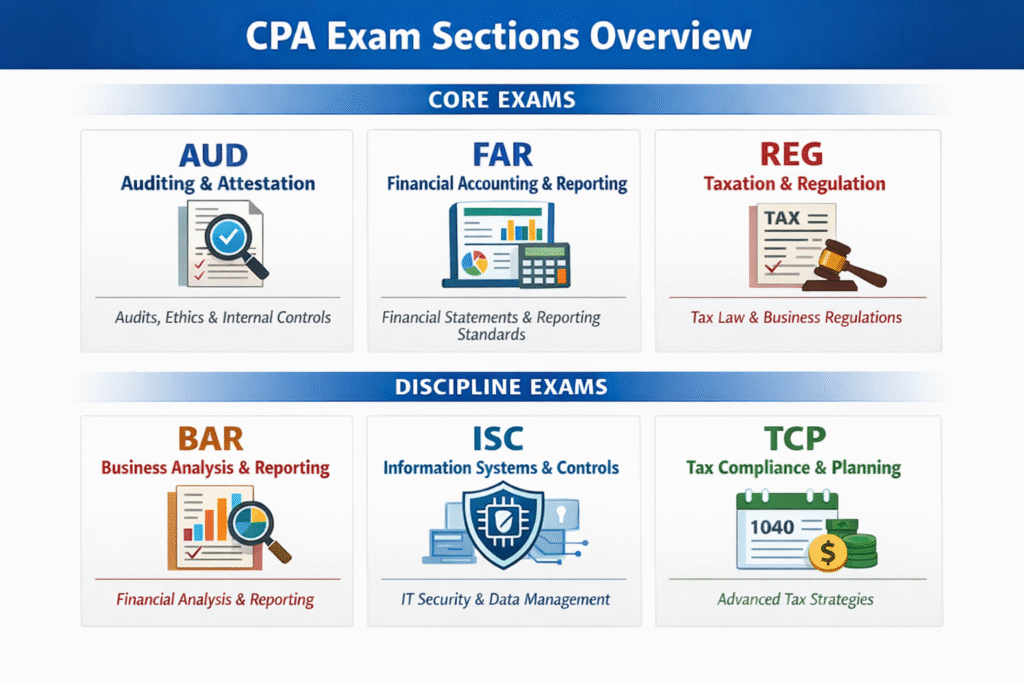
The CPA exam structure is designed to assess both breadth and depth. The three core exams ensure all candidates possess essential accounting knowledge and skills across auditing, financial reporting, and taxation. The discipline exams allow candidates to demonstrate specialized competency in an area aligned with their career goals.
Together, the core and discipline sections evaluate readiness to perform professional responsibilities as a licensed CPA. Mastery of financial reporting, auditing standards, tax practice, and business law principles reflects the comprehensive skill set required to earn a CPA license.
Final Thoughts on CPA Exam Sections
Ultimately, the CPA Exam sections are intentionally structured to reflect the modern accounting landscape. From financial accounting to federal tax compliance, the exam isn’t just a hurdle to climb; it’s a robust program that ensures you’re ready for the real world. By understanding how the core exams and discipline exams fit together (and why they’re there in the first place), CPA candidates can approach preparation strategically and align their discipline choice with their professional goals.
FAQs
The CPA exam consists of three required core sections and one discipline section, for a total of four sections that must be passed to qualify for licensure.
The core sections are Auditing and Attestation (AUD), Financial Accounting and Reporting (FAR), and Taxation and Regulation (REG).
Core sections test foundational accounting knowledge, while discipline sections allow candidates to demonstrate deeper expertise in a specialized area.
Yes. After completing the core exams, candidates select one discipline based on their interests or career goals.
Yes. Candidates must pass all required CPA exam sections within their jurisdiction’s time window to qualify for a CPA license.
