The CPA exam is no joke—and those ~40% pass rates make that point very clear.
But with the right study strategy, you can pass. I’m not here to give you a step-by-step, cookie-cutter guide that doesn’t actually work for a real person’s schedule. Instead, I’m going to help you create your own path based on your schedule, learning style, and budget.
Without further ado, let’s get started.
Key Takeaways
- Structure Beats Guesswork: A clear study plan matters more than random studying or motivation.
- Blueprints Keep You Focused: The CPA exam blueprints tell you exactly what to study and how deep to go.
- Practice Is Non-Negotiable: Practice questions and tests reveal gaps faster than rereading notes.
- Understanding Wins: The exam rewards application and reasoning, not memorization.
- Consistency Pays Off: Steady, realistic study habits matter more than short bursts of effort.
Studying for the CPA Exam: Start With the Big Picture
Before you open a book or video, you need to understand what you’re studying for.
The Uniform CPA Examination is broken into multiple CPA exam sections, each covering different material. Every exam section has its own focus, but the overall goal is the same: test whether you can apply accounting knowledge in realistic situations.
That’s where the CPA exam blueprints come in. These blueprints outline what’s tested, how deeply it’s tested, and how topics are weighted. I always recommend reviewing the exam blueprints first. They keep your studying grounded and prevent wasted time.
This step alone separates focused CPA candidates from overwhelmed ones.
Build a CPA Study Plan You Can Actually Follow
A good study plan isn’t about getting as much done as quickly as possible. Instead, it’s about making a schedule that realistically fits into your life.
Start by deciding which section you’ll tackle first and which testing windows you’re aiming for. Then work backward. It’s easy to be idealistic here, but try to make choices you’ll actually follow (and to be clear, this is easier said than done!). If you can’t stick to it, don’t beat yourself up; just adjust.
When you start studying, think in weeks, not days. Most candidates need several months per section. That’s normal.
Your plan should include:
- Content review
- Regular practice
- Time for review and weak spots
Generally speaking, short daily sessions beat long ones that happen once in a blue moon. Consistency should be your top priority here.
Match Your Study Method to Your Learning Style
Not everyone learns the same way, and pretending otherwise makes studying harder than it needs to be.
Your learning style might lean toward reading, watching lectures, or doing problems. Most people learn best with a mix of formats, but often, you’ll realize that one method just works better than the others (even if you crave variety).
A solid CPA review course often includes videos, text, and quizzes. Programs led by expert instructors can help clarify tricky topics faster than self-study alone.
That said, no course fixes bad habits. The tool matters less than how you use it.
Focus on Understanding, Not Memorization
The CPA exam is hard and doesn’t reward memorizing definitions. It rewards application.
You’ll see plenty of multiple-choice questions, but many are layered. You need to understand why something works, not just recognize it.
This becomes even more important with task-based simulations, which ask you to analyze scenarios and choose correct answers across multiple steps.
When reviewing topics, ask yourself:
- Why is this rule applied here?
- What would change the outcome?
That’s how real understanding develops.
Use CPA Practice Tests the Right Way
Practice tests are one of the most effective study tools for a wide number of reasons. You get to discover your strengths and weaknesses, learn by doing, and of course, see how well you’d perform on the actual exam.
That said, you don’t want to treat them like score checks without any strategy for applying your results back into your study plan. Instead, treat practice tests like diagnostics. Every missed question points to knowledge gaps or weak reasoning—and when you pick from the top CPA prep courses, those answer explanations will be invaluable in helping you revise your strategy for next time.
After each session:
- Review wrong answers carefully
- Understand why the right option is right
- Look for patterns in mistakes
This process builds confidence faster than rereading notes.
Understand How the Exam Is Scored
While it may seem like a waste of time, knowing how the CPA exam is scored may actually increase your score—before you’ve even taken the test.
Each section has specific score weighting across topics. Some areas matter more than others, and the blueprints tells you exactly which sections those are. Naturally, this isn’t an excuse to ignore topics with a lower weight. However, you may want to focus on topics with heavier weights more often.
The exam also balances difficulty across questions, so missing a few won’t doom you to a failing score. Focus on accuracy and pacing, not perfection.
Practice for Exam Day Conditions
It’s inarguable that understanding the content is a big deal, but so is understanding the format. When you walk into the test center, sit down at your computer, and start the exam, you want to feel deja vu—not immediate panic and fear.
The timing is brutal. Master it before you get halfway through the test—when the time is called.
You can build endurance by:
- Doing full-length sets
- Practicing with a timer
- Taking breaks strategically
Good study habits include simulating test conditions so nothing feels unfamiliar when it counts.
Adjust as You Go
No study plan survives contact with real life unchanged.
Pay attention to what’s working and what isn’t. If a topic keeps tripping you up, slow down. If you’re consistently strong somewhere, move on.
There are other aspects of prep beyond content, like stress management and pacing. Ignoring those can hurt performance just as much as weak knowledge.
Studying for the CPA is iterative. Adjustments are part of the process.
Put in the Work (There’s No Way Around This)
At some point, it comes down to hard work.
There’s no shortcut that replaces time spent practicing, reviewing, and thinking through problems. The candidates who pass the CPA exam aren’t necessarily the smartest. They’re the ones who showed up consistently, even when motivation dipped.
That’s the part people don’t like hearing, but it’s also what makes success repeatable.
Conclusion
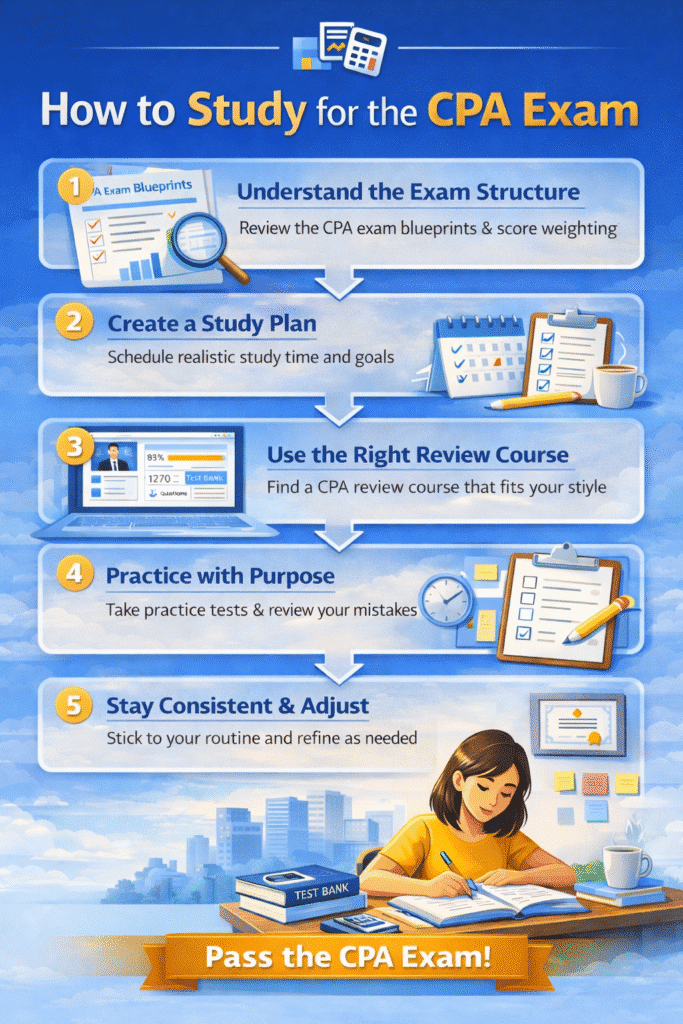
If you’re serious about studying for the CPA, the journey ahead isn’t easy, but it is doable. Understand the exam structure, build a realistic plan, practice with purpose, and adjust as you go (because hey, life happens).
Studying well isn’t about doing everything. It’s about doing the right things, repeatedly, until they stick. Commit to the process, and passing becomes a matter of when, not if.
FAQs
Most candidates start studying several months before their exam section, depending on workload and familiarity with the material.
Many test takers aim for 10–20 hours per week, adjusting based on their schedule and progress.
Yes. Practice tests help identify weak areas, improve timing, and prepare you for how questions are actually presented.
Not necessarily. Each section has different content and demands, so your approach may need to change slightly.
Studying without a plan or skipping review leads to repeated mistakes and wasted time.