If you’ve spent any time researching CIA prep, you’ve probably seen Gleim come up more than a few times. They’ve been around for decades, and they’ve built a reputation as a “safe bet” for CIA prep.
But how true is that label?
After spending time inside Gleim’s CIA course and studying like a student, here are the pros, cons, key features, and even Gleim’s little quirks (that everyone else isn’t talking about). For an honest, inside look, read on.
Quick Take: Is Gleim CIA Right for You?
- If you want a structured study plan that tells you exactly what to do each day, Gleim excels, with a personalized schedule and section due dates.
- If you like shorter study blocks that feel manageable, Gleim’s topic design makes it easy to stay moving and motivated.
- If you prefer academic-style explanations and exam-style wording, Gleim stays very true to the real exam tone.
- If you want highly engaging, energetic video instruction, you may prefer Becker instead.
- If you rely heavily on long, conversational answer explanations to fully understand concepts, Surgent may feel more accessible.
Gleim CIA Course Overview: What You’re Getting

Gleim’s CIA Review is built around three parts of the CIA exam and powered by their SmartAdapt™ adaptive technology. The goal is simple: keep adjusting your study path based on performance.
Here’s what stood out while using it:
- ~3,000+ multiple-choice questions
- 45+ hours of video lectures
- 6 mock exams (Premium version)
- Adaptive quizzes
- Digital books and flashcards
- Built-in study planner
- Access until you pass guarantee
My favorite part?
The ease and simplicity. As I moved through Part 1, everything followed a predictable rhythm: short content videos, quick MCQ walkthroughs, a concise outline, then focused practice. I never had to guess what came next.
The platform leans academic rather than flashy. The outlines use the same terminology you’ll see on the actual CIA exam, and the analytics make it easy to see where you’re strong and where you need more review. It isn’t the most high-energy course I’ve used, but it feels disciplined and very intentional in how it prepares you.
Pros
-
Strong adaptive tracking with clear topic-level breakdowns
-
Short, manageable topic segments
-
Very exam-aligned wording and structure
-
Comprehensive study planner
-
Access Until You Pass guarantee
Cons
-
Explanations are short and somewhat academic
-
The 14-week structure per part can feel rigid
Course Package Options
Gleim offers three versions of its CIA review, and the differences mostly come down to how much structure and support you want.
CIA Premium Review with SmartAdapt™
Premium is the complete course, and the one most candidates should consider. It includes the adaptive SmartAdapt™ system, video lectures (45+ hours), six mock exams, digital and printed books (on request), flashcards, and access to both a personal counselor and accounting experts.
If you want the most comprehensive setup with built-in support and multiple full-length simulations, Premium is the safest choice.
Traditional CIA Review with SmartAdapt™
The Traditional CIA Review keeps the adaptive course, study planner, books, and unlimited practice exams, but reduces the mock exams to three and doesn’t include flashcards or direct accounting expert access.
Traditional is a good middle ground if you want the adaptive structure and support without every add-on.
CIA Test Bank
The test bank is the stripped-down option. You get the question bank, digital books, and unlimited practice exams, but no videos, adaptive planner, or mock exams.
The CIA Test Bank is best for someone who already understands the content and just wants focused practice.
| Feature | Premium | Traditional | Test Bank |
|---|---|---|---|
| SmartAdapt™ |  | |  |
| Video Lectures | | | |
| Mock Exams | 6 | 3 | |
| Personal Counselor | | | |
| Accounting Expert Access | | | |
| Unlimited Practice | | | |
| Price | $1,249 | $1,099 | $499 |
What Studying Actually Feels Like
The Study Units
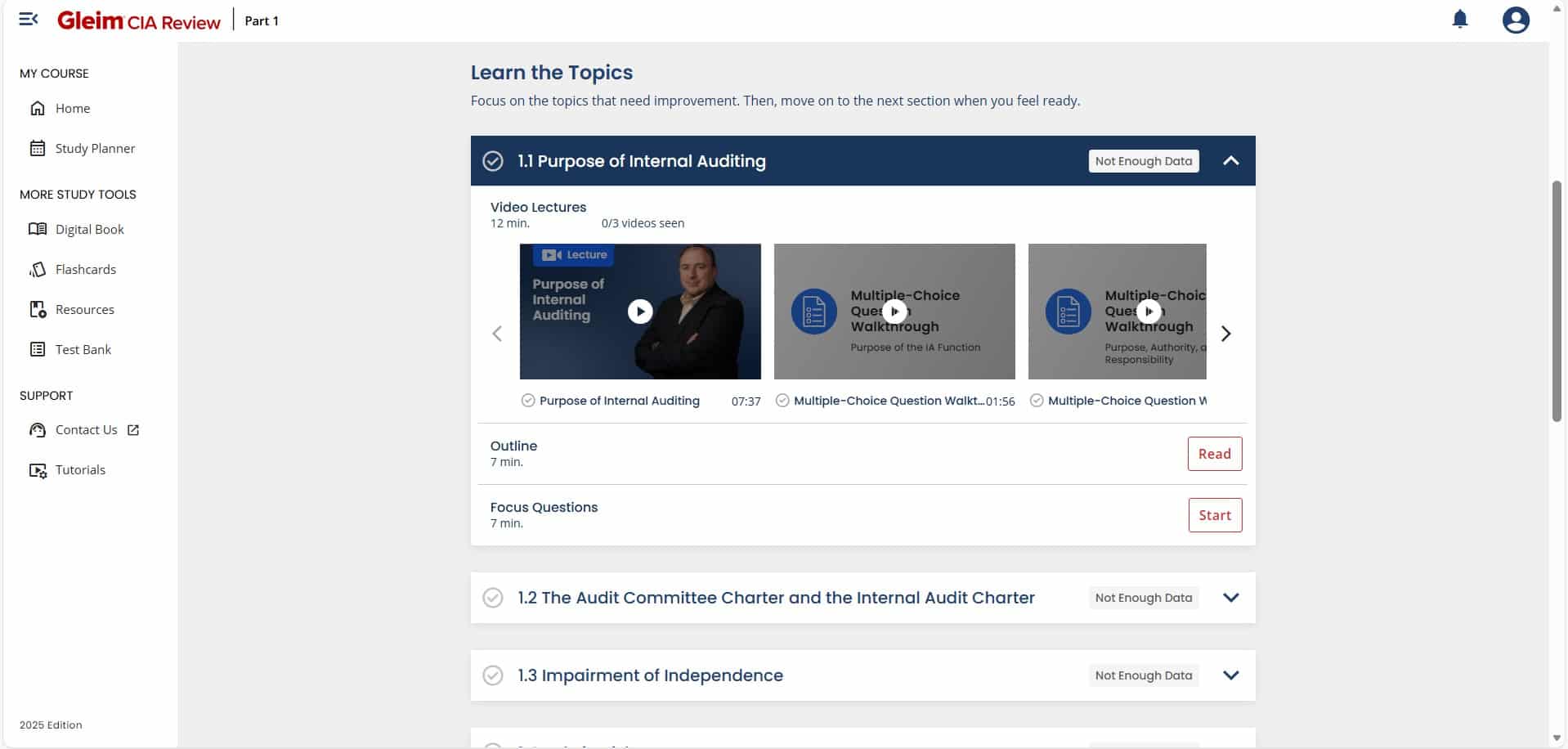
Part 1 consists of 10 study units. Each unit breaks into topics (for example, 1.1–1.4). A typical topic includes:
- One main content video
- Two short MCQ walkthrough videos
- A written outline (usually 5–10 minutes of reading)
- 3–5 focus questions
I timed a handful of sessions. Including videos, reading, and focus questions, each topic took about 20–25 minutes. That’s shorter than an episode of The Simpsons. There’s something motivating about finishing a full section in under half an hour; it kept my momentum rolling, making it that much easier to say “just one more section.”
The only annoyance: when watching videos, it automatically rolls into the next topic’s videos instead of bringing you back to the outline for the current topic. It’s a small UX issue, but I found myself clicking back more often than I’d like. Overall, though, Gleim’s organization is easily one of my favorites—not just for CIA, but for any exam. They truly nail this aspect of exam prep.
Video Lectures
The average content video runs about 7 minutes and 50 seconds (I averaged the first 10). MCQ walkthrough videos are often closer to 2 minutes.
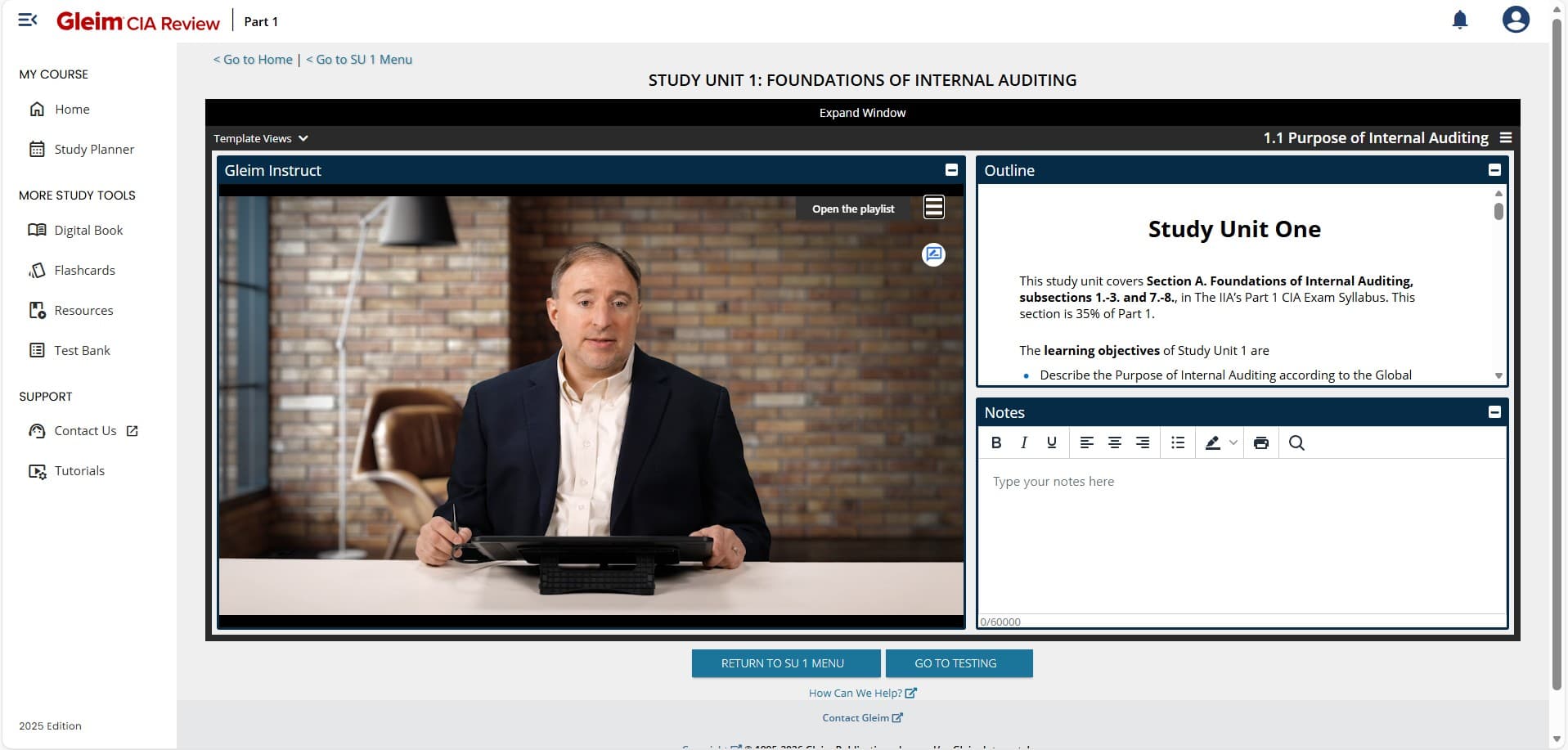
The instructor, Joseph Mauriello (Ph.D., CIA, CMA, CPA), is clearly knowledgeable. His delivery is professional and steady. The audio quality is strong. He explains thoroughly.
That said, he isn’t as high-energy as other instructors, like Becker’s Mike Brown. However, the blunt, straight-to-the-point teaching style was actually great for me. I’m the kind of person who picks up on something pretty quickly, and I tend to value efficiency over enjoyment. I’d rather watch a 5-minute video that’s more dry than a 10-minute video with plenty of jokes and pitch changes.
So, know thyself. If you need that extra energy, Gleim might not be the best fit. For comprehension that respects your time, Gleim is a winner.
Outlines and Written Content
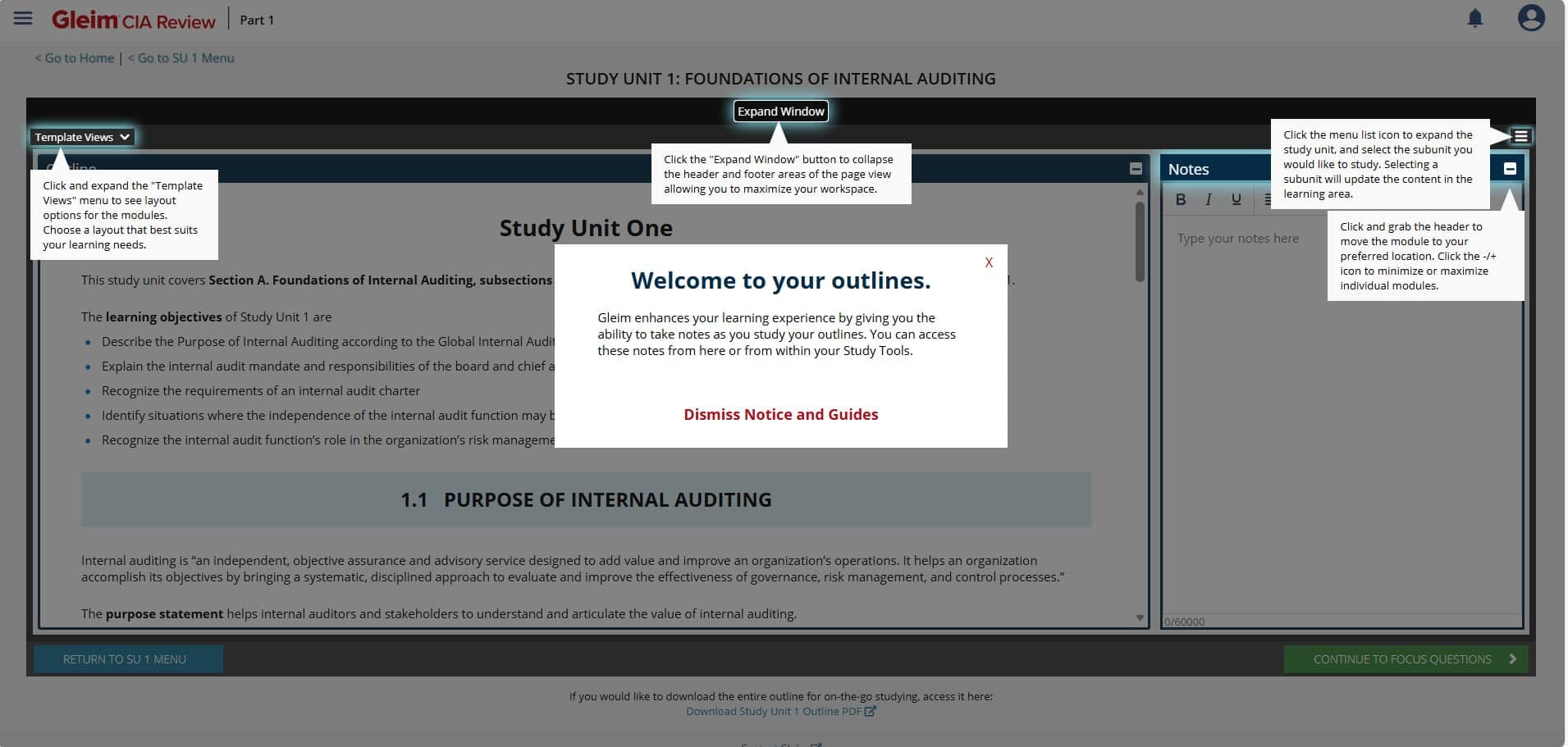
The outlines use the same terminology you’ll see on the actual exam, which is a big plus. However, this does mean you’re not looking at light reading. Luckily, though, the outlines are succinct; it usually took me just 5 to 10 minutes to get through them.
The formatting broke down that density, too, with bolding, bullet points, and small sections. Further, I liked having the outline open next to the video without needing a separate Google Doc for notes; it was a lot more efficient (and frankly, less annoying) than having the course in one window and Doc in the other.
If you’ve been out of school for a while, the academic tone might feel like brushing off some rust. It’s not casual reading, but it’s clear and structured, and the lingo suggests students are studying for the exam in greater depth than they might in a more conversational course.
Question Quality & Explanations
The questions feel very exam-aligned, and having potentially over 3,500 of them is major.
The explanations, however, are on the shorter side; I averaged about 121 words across several samples. Typically, there’s one concise sentence per answer choice, which doesn’t always go into the depth I wanted.
They clearly explain why an option is right or wrong, just in a straightforward, no-frills way. If you prefer longer, more step-by-step breakdowns, you might want a bit more detail. However, if you value quick, direct feedback so you can move through questions efficiently, this approach works well.
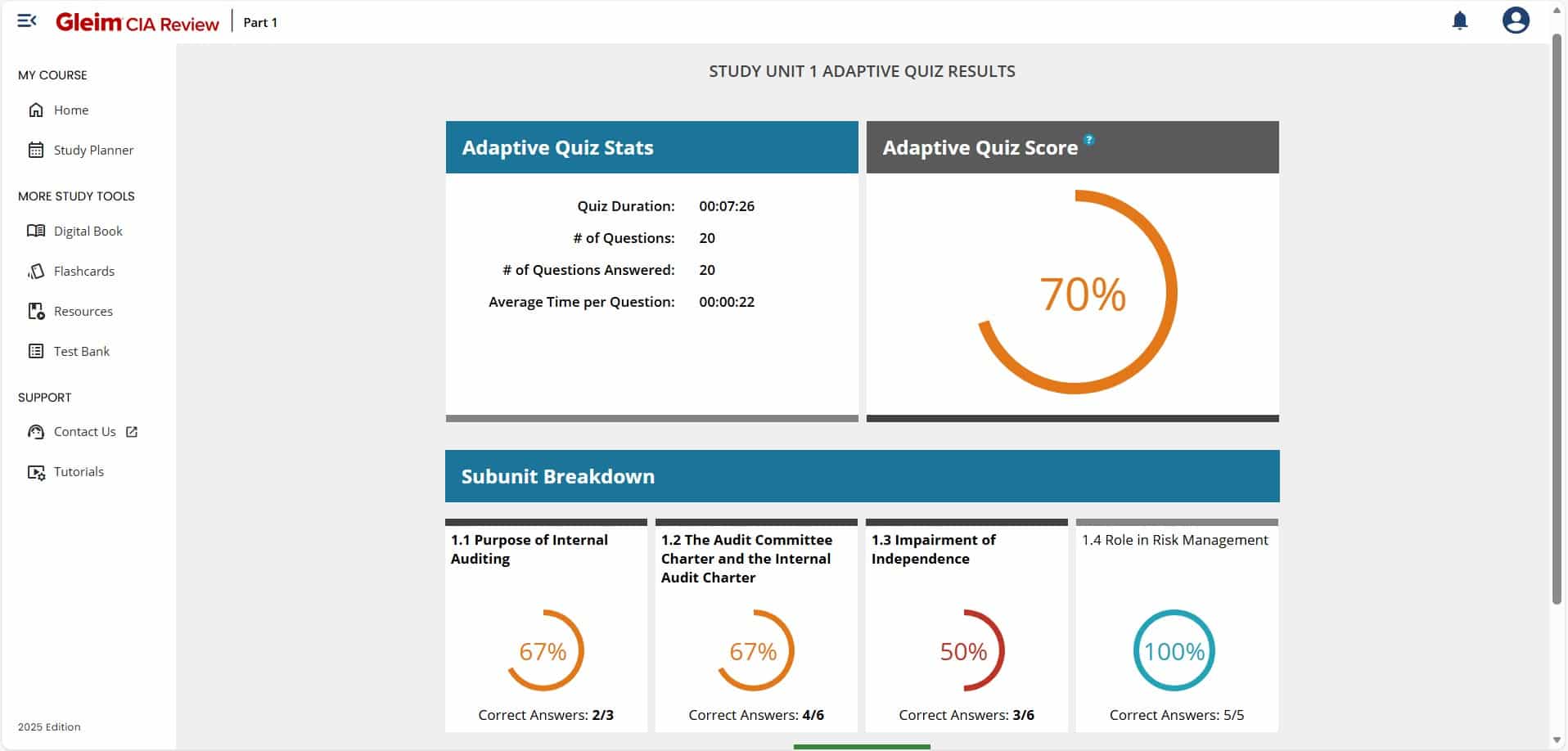
As for analytics and review, after completing a 20-question adaptive quiz, I got detailed performance data:
- Total time spent
- Average time per question
- Topic-by-topic performance
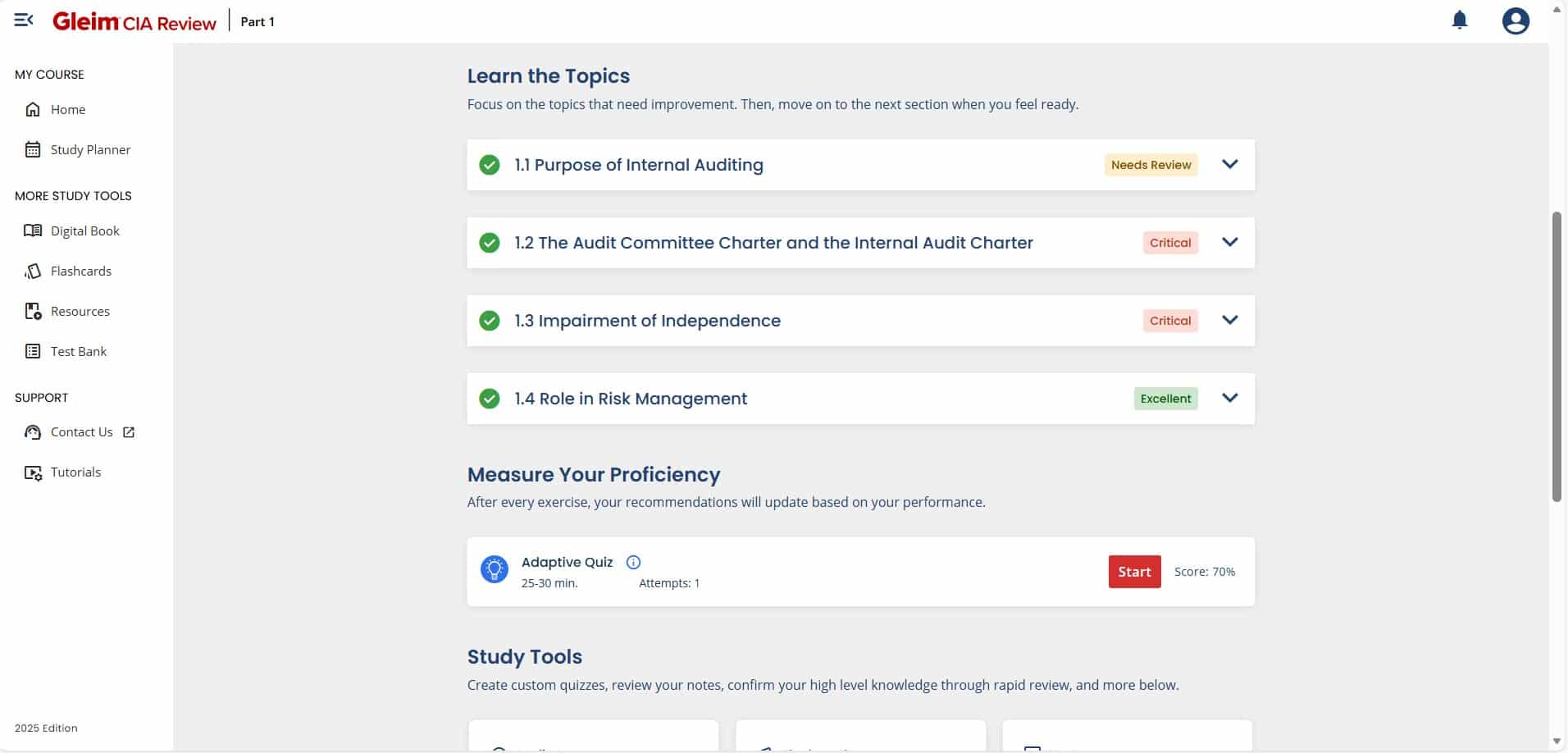
For example, I scored 70% overall. Once I moved back to the study unit, I saw color-coded breakdowns:
- Green for “excellent”
- Yellow for “needs review”
- Red for “critical”
It was immediately clear what I needed to revisit, and that feedback loop is one of Gleim’s strongest features.
How Gleim CIA Stacks Up Against Competitors
| Feature | Gleim | Becker | Surgent | PRC |
|---|---|---|---|---|
| Adaptive Technology | SmartAdapt™ | Adapt2U | Adaptive Engine | Limited |
| Study Planner | Structured (14-week framework) | Flexible & customizable | Adaptive planner | Basic |
| Question Bank | 3,000+ | 2,500+ | 3,000+ | 1,800+ |
| Explanations | Concise (~121 words avg.) | Thorough and substantial | Concise | Basic |
| Coaching/Tutoring | Personal Counselor | Coaching + Tutoring (higher tiers) | Limited | Minimal |
| Access Until You Pass | Yes | Yes | No (18 Months) | No (18 Months) |
Gleim vs Becker CIA Review
Becker and Gleim are both structured and thorough, but they feel different in execution. Becker’s biggest strength is delivery. The instructors are more energetic, and the explanations are more conversational.
When I was watching Becker videos, it felt like someone was walking me through the material in plain English. Plus, the live classes can be the difference between showing up and procrastinating until “tomorrow” (whenever that is).
Gleim, by comparison, is more academic. The outlines mirror exam language closely, and the tone is more formal. If you’ve been away from school for a while, Gleim almost feels like easing back into a textbook environment. Where Gleim shines is in discipline. The 14-week structure per part and the color-coded SmartAdapt feedback make it very clear what to review. Becker is more flexible and smoother overall, but Gleim’s tracking can feel slightly more granular.
Choose Becker if you want more engaging video instruction and a slightly smoother overall experience.
Pick Gleim if you prefer a structured, academically grounded system with very targeted adaptive feedback.
Gleim vs Surgent CIA Review
Surgent leans heavily into adaptive technology and analytics. It adjusts difficulty quickly and provides strong performance dashboards. If you enjoy data-driven study plans and rapid recalibration based on performance, Surgent does that well.
Gleim, however, feels more complete in terms of written materials and structured progression. The outlines are more robust, and the 14-week framework gives clearer pacing guardrails. Surgent can feel a bit more fluid; Gleim feels more mapped out.
Choose Gleim if you want a disciplined study structure and strong written outlines.
Pick Surgent if you prefer a more aggressive adaptive engine and analytics-heavy experience.
Gleim vs PRC CIA Review
PRC is simpler overall. The platform focuses primarily on core content delivery and practice questions with less adaptive refinement and structured planning. For some candidates, that simplicity is appealing. There’s less to navigate, and the experience feels straightforward.
Gleim offers more in terms of structure, analytics, and support. The SmartAdapt system, mock exams, and access to a personal counselor make it a more guided experience. If you’re looking for a comprehensive system rather than a basic question bank, Gleim is the stronger option.
Choose Gleim if you want structured planning, adaptive feedback, and deep mock exams.
Pick PRC if you prefer a more streamlined, less feature-heavy study setup.
Bottom Line
Gleim CIA Review is thorough, disciplined, and very exam-focused. Adaptive tracking saves precious time and energy, the study structure keeps you moving, and, most importantly, the content closely mirrors the real exam.
Flashy? Not really. But Gleim is polished, with professional video lessons, strong analytics, and concise explanations.
If you want structure and a focus on remembering the material, Gleim is a strong choice (and beautifully designed for my ever-withering attention span). If you want more engaging instruction and live online classes, Becker may be a better fit.
FAQ
Gleim CIA offers over 3,000 multiple-choice questions, with some estimates reaching over 3,500.
Yes. The Premium system includes an Access Until You Pass guarantee.
They’re professional and clear, but not high-energy. They break down topics well, and they’re short enough to stay focused, even if they aren’t the most exciting.
For structured planning and exam alignment, many candidates may prefer Gleim. For adaptive analytics, Surgent is also strong.
Gleim CIA is an excellent choice for CIA candidates, with quick lessons, adaptive technology, and an easy-to-follow study flow.
Leave a Reply
You must be logged in to post a comment.